

Raymond Harries
Famous or "King Cobras"
from the North Africa/Italy era and mid-late WW2
Extraordinary men in an exceptional Squadron
Please click on an image for a short biography


Ronnie Fokes
Jefferson Wedgwood
John Carpenter
William Chisholm
James Samouelle
John Milne Morgan

William John Harper

Peter Humphreys
Evan Mackie

James Edwards

Charles "Paddy" Green

Graham Cox

Johnny Gasson

Wing Commander Raymond Hiley “Ray” Harries was one of the Royal Air Force’s top-scoring Spitfire pilots and among the few to be awarded the Distinguished Service Order (DSO) and Bar as well as the Distinguished Flying Cross (DFC) and Two Bars — a testament to his extraordinary courage, leadership, and consistent operational brilliance throughout the Second World War.
Born in 1916 in Swansea, Wales, Raymond Harries joined the Royal Air Force Volunteer Reserve (RAFVR) in 1939, shortly before the outbreak of the Second World War. Following his pilot training, he was posted to No. 43 Squadron in 1940, flying Hawker Hurricanes during the later stages of the Battle of Britain.
In 1941, Harries transitioned to the Supermarine Spitfire, joining No. 91 (Nigeria) Squadron, which would become his home unit and the stage for his rise to fame as a combat leader. Demonstrating a natural aptitude for air fighting and gunnery, Harries scored his first victories during offensive operations over northern France and quickly developed a reputation as a brilliant marksman and tactician.
By mid-1942, he had become a Flight Commander, leading Spitfire sweeps and bomber escort missions across the Channel. His personal combat tally rose steadily, and his determination to lead from the front earned him both the Distinguished Flying Cross (DFC) and two subsequent Bars — each recognising repeated acts of conspicuous gallantry.
In 1943, Harries was promoted to Squadron Leader and took command of No. 91 Squadron, later followed by No. 222 Squadron RAF. His leadership was marked by tactical innovation and an ability to inspire confidence in younger pilots. During this period, he also became one of the first RAF pilots to fly and score victories in the Supermarine Spitfire Mk IX, one of the most advanced variants of the war.
Harries’ total of 15 confirmed victories — all scored while flying Spitfires — established him as one of the type’s top-scoring aces. For his continued success and leadership under fire, he was awarded the Distinguished Service Order (DSO), followed later by a Bar to that award in recognition of his outstanding command of multiple fighter squadrons during the later phases of the war.
After the war, Harries remained in the RAF, serving in a variety of senior flying and staff appointments. He played a role in the early development of jet operations during the late 1940s and early 1950s,
Postwar service
After the war Harries was awarded a bar to the DSO, and served as commanding officer No. 92 Squadron RAF in 1949. On 14 May 1950 he died while flying a No. 92 Squadron Gloster Meteor F4 when it ran out of fuel and crashed near Sheffield, Yorkshire. His funeral was held at RAF Linton-on-Ouse on 18 May 1950.


Service Details
-
Service Number: 41438
-
Rank: Wing Commander
-
Units: No. 43, No. 91 (Nigeria), No. 222, and related Fighter Command squadrons
-
Aircraft: Hawker Hurricane, Supermarine Spitfire (Mk V, Mk IX)
-
Theatres: Battle of Britain, Channel Front, Normandy, Western Europe
Harries’ 1950 death marked the tragic end of one of the RAF’s most successful Spitfire aces — a man who transitioned into the jet age and was leading 92 Squadron during its Meteor era. His loss was felt deeply in the post-war RAF, particularly within the fighter community, as he represented the continuity between the propeller-driven heroes of 1940–45 and the emerging jet generation.

Service Details
-
Rank: Squadron Leader
-
Service Number: (RAFVR, not publicly recorded)
-
Unit: No. 92 (East India) Squadron RAF
-
Aircraft: Supermarine Spitfire
-
Theatres: Battle of Britain, Western Europe, Channel Front
Squadron Leader Ronald Henry “Ron” Fokes was one of the most accomplished non-commissioned aces of the Royal Air Force, whose courage, determination, and skill as a Spitfire pilot earned him the Distinguished Flying Medal (DFM) and Bar, followed by the Distinguished Flying Cross (DFC) after his commission. His exemplary record places him among the finest combat pilots to have served with No. 92 (East India) Squadron RAF.
Born in 1917, Ronald Fokes joined the Royal Air Force Volunteer Reserve (RAFVR) before the outbreak of the Second World War. After completing his pilot training, he was posted to No. 92 Squadron, which flew the Supermarine Spitfire and was heavily engaged in front-line operations throughout the Battle of Britain and the following years of air combat over occupied Europe.
During the Battle of Britain, Fokes quickly established himself as a fearless and reliable pilot. His keen eyesight, quick reactions, and aggressive flying style led to a series of aerial victories against German fighters and bombers. For his outstanding bravery and effectiveness in combat, he was awarded the Distinguished Flying Medal (DFM) in late 1940.
His continued success in offensive operations during 1941 — including escorting bombers and flying low-level “Rhubarb” missions into France — earned him a Bar to his DFM, making him one of a small number of RAF pilots to be twice recognised for gallantry while still a non-commissioned officer.
Fokes was subsequently commissioned and continued to serve with distinction as an officer pilot and flight commander. His leadership qualities, coupled with his proven combat record, earned him the Distinguished Flying Cross (DFC), recognising his “outstanding gallantry, initiative and devotion to duty in repeated air operations.”
By the end of his operational flying, Squadron Leader Fokes had achieved a total of at least 8 confirmed victories, with several more probables and damaged enemy aircraft. He was widely respected within 92 Squadron for his steadiness under pressure and for his quiet professionalism — characteristics that made him both an effective leader and a mentor to younger pilots.

Ground crew attend to Spitfire Mk I GR-A after a landing accident at RAF Pembrey on 22 July 1940. The pilot was Sgt Ronald H "Ronnie" Fokes who returned from a night sortie when the port undercarriage leg collapsed. At the time, No 92 Squadron RAF used the code GR when based at the airfield and QJ when stationed at RAF Biggin Hill.

After the war, Fokes remained involved with the aviation community and maintained close ties with his wartime comrades through the 92 Squadron Association. He lived a private life in post-war Britain, passing away in 1999 at the age of 82.
Ronald Henry Fokes remains remembered as one of 92 Squadron’s finest pilots — a courageous and skilled airman whose remarkable series of awards testifies to sustained bravery in the face of overwhelming odds.

Service Details
-
Rank: Podporucznik (Pilot Officer, RAFVR)
-
Units: No. 303 (Polish) Squadron RAF; No. 92 (East India) Squadron RAF; No. 315 (City of Dęblin) Squadron RAF
-
Aircraft: Supermarine Spitfire
-
Theatres: Battle of Britain, Western Europe
Adolf Pietrasiak was a distinguished Polish fighter ace of the Second World War who fought with exceptional courage alongside the Royal Air Force during the Battle of Britain and later in the European theatre. Decorated by both Poland and Britain for bravery, he is remembered as one of the many gallant Polish airmen who gave their lives for the freedom of Europe.
Born on 17 November 1916 in Kota, near Radomsko, Poland, Pietrasiak joined the Polish Air Force before the outbreak of war. Following the German invasion of Poland in September 1939, he escaped through Romania and France, eventually reaching Britain in 1940, where he joined the Royal Air Force Volunteer Reserve (RAFVR) and began flying the Supermarine Spitfire.
After initial training with No. 58 Operational Training Unit (OTU), Pietrasiak was posted to No. 303 (Polish) Squadron RAF, one of the most famous and successful units of the Battle of Britain. He quickly proved himself a determined and fearless pilot, taking part in multiple engagements with the Luftwaffe over southern England.
Later, he transferred to No. 92 (East India) Squadron RAF, another elite Spitfire unit, where his flying skill and combat instinct earned the respect of his British and Commonwealth comrades. Known affectionately as “Pietra,” he continued to score victories in combat over occupied France, often flying dangerous “Rhubarb” low-level missions.


For his bravery and repeated gallantry in action, Pietrasiak was awarded the Polish Cross of Valour (Krzyż Walecznych) on four occasions, the Virtuti Militari (Silver Cross) — Poland’s highest military decoration for valour — and the British Distinguished Flying Medal (DFM).
Tragically, Podporucznik Pietrasiak was killed in action on 29 November 1943 while serving with No. 315 (City of Dęblin) Polish Fighter Squadron. His Spitfire Mk IX (serial MA340) was believed to have been shot down by German fighters during a bomber escort mission over France. His body was never recovered, and he is commemorated on the Polish War Memorial at Northolt and at the Commonwealth Air Forces Memorial, Runnymede.
Adolf Pietrasiak was credited with at least 8 confirmed aerial victories and remains one of the finest examples of the courage and skill displayed by the Polish pilots who fought within the RAF during the war. His service with 92 Squadron stands as a proud symbol of international cooperation and shared sacrifice in the defence of freedom.
Squadron Leader Jefferson Wedgwood DFC & Bar
(28 May 1917 – 17 December 1942)

Service Details
-
Rank: Squadron Leader
-
Service Number: 41435
-
Unit: No. 92 (East India) Squadron RAF
-
Aircraft flown: Supermarine Spitfire
-
Theatres: Battle of Britain; Western Desert & Mediterranean
-
Date of Death: 17 December 1942 (friendly fire, Malta)
-
Age: 23
-
Burial: Capuccini Naval Cemetery, Malta
Squadron Leader Jefferson Alfred Wedgwood, DFC & Bar, was a talented and gallant Royal Air Force fighter pilot who served with distinction in No. 92 (East India) Squadron during some of the fiercest air battles of the Second World War.
Born in 1919, Wedgwood joined the Royal Air Force before the outbreak of war and qualified as a fighter pilot on the Supermarine Spitfire. He was posted to No. 92 Squadron, one of the RAF’s most famous and effective fighter units, where he took part in the Battle of Britain and the squadron’s later offensive operations over occupied Europe.
Wedgwood quickly established himself as a daring and gifted pilot. His cool-headed leadership and accuracy in combat won him the Distinguished Flying Cross (DFC), followed by a Bar to the DFC in recognition of further gallantry and success. He rose to the rank of Squadron Leader, commanding men in one of Fighter Command’s most respected Spitfire squadrons.
In December 1942, after a demanding tour in the Mediterranean theatre, Wedgwood was travelling as a passenger aboard a Handley Page Halifax transport aircraft en route to England for rest and reassignment. Tragically, on 17 December 1942, the aircraft was mistaken for an enemy bomber and shot down by British anti-aircraft guns over Malta. All on board were killed.
He was 23 years old. Squadron Leader Wedgwood was buried with full military honours at Capuccini Naval Cemetery, Malta, alongside many other RAF and Fleet Air Arm personnel who lost their lives defending the island.
A courageous and inspirational leader, Jefferson Wedgwood was remembered by his comrades in 92 Squadron as “a steady, fearless officer of fine judgement and unfailing humour.” His name endures among the finest pilots of the Royal Air Force’s fighter arm.


Squadron Leader 'Chips' Carpenter, who has died aged 83, accounted for at least eight enemy aircraft in the Battle of Britain and the siege of Malta.
At only 19, Carpenter was lucky to be alive when he joined No 222 Squadron in May 1940. He was one of the few survivors of the Gladiator-equipped No 263 Squadron, which had fought during the ill-fated Norwegian campaign. As the Germans overran Norway, the squadron was ordered to fly to the aircraft carrier Glorious, which was to sail for Scapa Flow. But he was not allocated one of the surviving aircraft, so he made his way home by ship while Glorious was sunk with the loss of most of his squadron's pilots.
He had just 50 hours on Spitfires when No 222 was sent to Hornchurch and thrown into the Battle of Britain. In a hectic week, beginning on August 30, Carpenter shot down three enemy fighters, claimed another as a probable, and was himself shot down and forced to bale out. Finally, on September 3, he was hit by "friendly fire" and blown out of his Spitfire. He parachuted to safety, but was badly wounded and remained in hospital for six weeks.
After returning to No 222, he captured the mood of a fighter pilot's life when he wrote to his mother on October 30: "More exciting events to report. We ran into 80 enemy fighters at 30,000 ft and I dived down and had a good old blast at one of them, but before I had finished I was myself attacked by two Me 109s and was absolutely peppered with cannon fire. The instrument panel broke up in front of me and the engine started thumping and vibrating when I thought it might shake the wings off.
"I managed to struggle back to the aerodrome after coming down through 3,000 ft of thick cloud with no instruments. I managed with a bit of luck and then made an ordinary landing, but one wheel collapsed and I was stuck in the middle. There were over 300 holes in the fuselage, the wireless had been shot away and the aircraft looked like a sieve. Nothing more to tell you now. Will write again soon. Love John."
John Michael Vowles Carpenter was born on April 21 1921 at Rhos-on-Sea. After attending Clifton College, he joined the RAF in 1938 and trained as a pilot at the Civil Flying School, Redhill.
Soon after joining No 46 Squadron in April 1941, Carpenter and his fellow Hurricane pilots embarked on the aircraft carrier Argus and sailed for the Mediterranean. At Gibraltar they transferred to Ark Royal and, on June 6, they took off from the carrier, arriving at Hal Far airfield on Malta, much-needed reinforcements, as the re-numbered No 126 Squadron.
Carpenter's first success over Malta was on June 30, when he led a section of six aircraft which intercepted Italian Macchi 200 fighters, one of which he shot down. Three weeks later, on August 20, he shot down a balloon during an attack on the seaplane base at Augusta, but his aircraft controls were badly damaged by anti-aircraft fire. Despite this, he flew his aircraft over 120 miles of sea to Malta.
From September he was in constant action, leading his flight and accounting for another four aircraft, including a Junkers 88 bomber as it approached the island. After six months of intensive operations, he was awarded the DFC for "consistently showing great courage and fighting spirit".
After a period instructing fighter pilots in South Africa, Carpenter returned to operations with the Desert Air Force, flying Spitfires with 145 and 92 Squadrons, before being promoted to squadron leader and taking command of No 72 Squadron in January 1944. Based at Lago in Italy, Carpenter led his squadron on bomber escort duties and provided fighter support and beach patrols during the landings at Anzio. He returned to England in May, and shortly afterwards was awarded a Bar to his DFC for his leadership in Italy. He then tested Typhoon and Tempest fighters for Hawkers.
After the war, he was granted a permanent commission. He held numerous flying appointments on fighter squadrons before being appointed as the adjutant of No 601 (County of London) Auxiliary Squadron, known as "The Millionaires' Squadron". He commanded No 80 Squadron from 1951 to 1954, providing air defence for Hong Kong, initially with Spitfires and then with the powerful twin-engine Hornet. After serving at HQ Fighter Command, and an appointment as a fighter controller, Carpenter retired from the RAF in 1959 to operate hotels on Bermuda and in South Africa.
Carpenter had a light-hearted attitude, believing that enjoyment was the key to happiness. After his first wife, Gwendoline, died in 1974, he took up sailing; he and his dog, Hardy, sailed to Poole, where he was reunited with a wartime friend, Becky, who had once worked at Chez Nina, the London nightclub beloved by RAF pilots. They married, and Becky ran a members' club, which she called the New Fitz, while "Chips" had a café in the area. After Becky's death in 1989, Carpenter moved to Devon, where he died on February 11.


There are copies of letters written by "Chips" on the Imperial War Museum website, click this postcard


William Lawrence “Red” Chisholm was born on 29 August 1916 in Berwick, Nova Scotia. Before the war he worked as a brakeman for the Canadian Pacific Railway and lived in Kentville, Nova Scotia.
Chisholm enlisted in the Royal Canadian Air Force in 1940 and, after training in Canada, was posted overseas.
Following his training, Chisholm was seconded to the Royal Air Force (RAF) and posted to No. 610 Squadron, equipped with Supermarine Spitfires. He flew in the thick of the Battle of Britain, where his bright red hair earned him the nickname “Red.” His aggressive flying style, leadership, and courage under fire gained him a strong reputation among his peers and superiors alike.
Later, Chisholm joined No. 416 (RCAF) Squadron and eventually became a flight commander. His tactical skill and accuracy in combat saw him credited with multiple aerial victories over enemy fighters and bombers, and he participated in both offensive sweeps over occupied Europe and defensive operations over Britain.
He joined No. 92 Squadron (RAF) in November 1941 and served with that unit through the Middle East and North African campaigns. During his time with 92 Squadron he was promoted and served as a flight commander (notably B Flight) — his leadership of the flight was explicitly mentioned in his Distinguished Flying Cross citation. His period with 92 Squadron is recorded as 5 November 1941 – 16 April 1943 (after which he returned to Canada for recruiting and training duties).
For his courageous and skilful leadership in the desert campaign Chisholm was awarded the Distinguished Flying Cross (DFC) (effective 1 Feb 1943) and a Bar to the DFC shortly afterwards (effective 23 Feb 1943). Contemporary reports and the squadron narrative credit him with several confirmed victories (multiple “kills”, probables and damaged) during this period.
In early 1944, Chisholm was appointed Squadron Leader of No. 412 (RCAF) Squadron, operating as part of the Second Tactical Air Force, flying cover and ground-attack missions in preparation for the Normandy landings. Tragically, on 30 May 1944, while returning from a mission over France, he was killed when his Spitfire Mk IX (serial MK783) crashed near Gravesend, Kent. He was 29 years old.
Squadron Leader Chisholm is buried in Brookwood Military Cemetery, Surrey, England. Remembered as a brave and inspiring leader, “Red” Chisholm embodied the spirit of the young Allied fighter pilots who risked everything for the liberation of Europe.
After his operational tour with 92 Squadron Chisholm served in various RCAF training and recruiting roles and later returned to civilian life in Nova Scotia. He passed away on 7 March 2005 in Kentville, Nova Scotia.

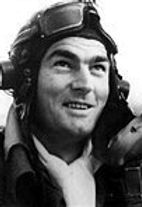
Sammy was clearly a handsome man who w ould have not been out of place in a Hollywood movie
Sammy joined No. 92 Squadron on 16 September 1941.
He also served with No. 41 Squadron and No. 130 Squadron as well as 92 Squadron during the war. He is commonly listed with the sequence 41 / 92 / 130 in ace lists.
Rank and awards: he is recorded in the London Gazette and other official sources as Acting Flight Lieutenant C. J. Samouelle (RAFVR) and was awarded the Distinguished Flying Cross (DFC) (with later Bar). The Gazette citation describes him as “a very determined and courageous fighter” and credits him with multiple destructions and damaged enemy aircraft while leading his flight.
Combat record / victories: specialist ace lists credit Samouelle with about 11 aerial victories (figures vary slightly by source). He appears in compiled ace lists for the UK as “Samouelle, Charles James (‘Sammy’) — 11”.
Operational theatres & notable actions: squadron histories and mission accounts place him in Mediterranean/North African and Italian theatre operations with 92 Squadron and show specific combat claims (for example a Bf 109 on 19 August 1942 and other claims while leading flights). The 92 Squadron narrative records Samouelle shooting down a Me 109 during a heavy engagement.
Later career / retirement: later references note he retired with senior rank (some sources note he retired as a Wing Commander), and the National Portrait Gallery entry and other biographical summaries list his decorations (DFC & Bar, OBE in some records)

John Morgan in a 92 Squadron Spitfire with 4 kill markings on the cockpit

John Morgan's medals
Drawing of John Morgan's descent in to enemy territory before being captured and interned at the infamous Sagan POW camp just three days after the famous "Great Escape".
John Milne Morgan was a native of Balham, London, and was born in 1916. He was educated at Bonneville Road School, Clapham Park and the Henry Thornton School, Clapham Common. He enlisted in the Royal Air Force Volunteer Reserve in 1935, and was commissioned Pilot Officer in 1938. Morgan carried out his initial pilot training at No. 8 E.F.T.S., Reading and No. 10 F.T.S., Tern Hill - being stationed at the latter when he saved the life of Pilot Officer W. A. Jenns when Hart K5795 crashed on 19 December 1938. He was posted as a pilot to No. 1 Anti-Aircraft Co-operation Unit, Farnborough in March 1939, and was still serving with the unit when war was declared in September of the same year. Morgan carried on serving with the unit with its various moves to Carew Cheriton and Cleave, and was doubtless frustrated by his posting as the Battle of Britain evolved. His limited aircraft - the Hawker Henley - did not stop him from having an optimistic go at an enemy aircraft on 6 September 1940: ‘Z.C. 6000. Spotted enemy aircraft 1,000ft below chased to Swansea, Spitfire took over.’
Destined for more glamorous flying opportunities, Morgan was posted to the famous 92 (East India) Squadron at the end of 1941. Like the rest of the squadron’s pilots he was attached to 80 Squadron in the Western Desert, whilst his parent unit was eventually kitted out with aircraft. Having destroyed several enemy aircraft whilst flying Hurricanes, Morgan was now unleashed on 92’s newly acquired Spitfires.
Morgan’s flying prowess quickly came to the fore, with him rapidly being appointed a Flight Commander, before receiving the ultimate accolade: the command of 92 Squadron in December 1942 - January 1943. He led from the front, ‘in the course of the fight [7 January 1943] I shot a 109G down in flames, crashing in the sea... and damaged a second. I finally had to fight two 109’s without ammunition for 30 minutes until my aircraft received hits from a head on attack which forced me to take evasive action - the 109’s then beat it home. This was a very shaky engagement with the bullets narrowly missing my head!!!’
Morgan subsequently commanded No. 234 Wing during the short-lived defence of the island of Kos, before being appointed to the command of 274 Squadron in October 1943. Now flying Spitfires as fighter bombers, Morgan led the Squadron into Italy and on many low-level attacks: ‘we attacked several Tiger tanks and armoured cars with front guns in the Capestrano area [24 January 1944]. I strafed a tank on a mountain pass which rolled over the side into the valley below...’
Morgan was shot down by anti-aircraft fire whilst carrying out a low-level strafe near Terni, 28 February 1944. In his words: ‘Shot down over the lines after gun fight - parachuted into captivity.’ He arrived to be interned at the infamous Stalag Luft III, Sagan, just three days after the ‘Great Escape’. Carrying on in service after the war, Morgan commanded 208 Squadron in the Canal Zone at the time of the fighting following the creation of the state of Israel


William Harper in a Hurricane with six confirmed Kills adorned under the cockpit

William Harper in later life, likely in Rhodesia
William John Harper was born in Calcutta on 22nd July 1916 and educated at North Point, India and Windsor, England. He joined the RAF on a short service commission in July 1937.
Posted at first to 6 FTS Netheravon on 18th September, he then went on to the staff at RAF Leuchars on 7th May 1938.
Harper was serving with 17 Squadron in early 1940 and over Dunkirk on 29th May he shared in probably destroying a Me110.
On 15th August Harper was flying one of six Hurricanes airborne to intercept 20+ German fighters. The six were reduced to three by Ground Control and in the event only Harper was able to make contact. After attacking and damaging a Me109 his Hurricane, P3891, was badly damaged and, with a dead engine, Harper made a crash-landing near Laurel Farm, Felixstowe.
He was admitted to Felixstowe Cottage Hospital with face and leg wounds.
On 23rd March 1941 he was posted to 57 OTU Hawarden to instruct. In October Harper was posted to the Far East and on 15th December 1941 took command of 453 (RAAF) Squadron at Ipoh. Its role was to defend ships of the Eastern Fleet and it was heavily engaged in battles. The pilots courageously fought until there were only five aircraft left and 453 moved back to Kuala Lumpur.
In spite of replacements, only three Buffalos were still serviceable on 22nd December.
21 and 453 Squadron were combined as 21/453 at Singapore on 24th December under Harper's command. It retired to Batavia in February 1942 and was disbanded on arrival at Adelaide on 15th March. Harper did not go to Australia but left the squadron at Colombo and was posted to India. He commanded 135 Squadron at Dum Dum in June/ July 1942 and 92 Squadron in North Africa from January to May 1943.
Harper retired from the RAF on 22nd April 1949 and emigrated to Rhodesia to begin farming. He later turned to mining and started an earth-moving business. In May 1958 he was elected to the Southern Rhodesian Parliament as Member for Gatooma.
Harper became President of the Dominion Party in 1959. He resigned on 2nd February 1962 to coordinate opposition to the United Federal Party Government. When the Rhodesian Front came to power on 17th December 1962, Harper became a Cabinet Minister.
On 13th April 1964, when Ian Smith was elected, Harper was appointed Minister of Internal Affairs. He split with Smith on 4th July 1968, resigned as an MP and left the Rhodesian Front Party.
He was out of public life until February 1972, when he became one of the founders of the United Front Party. He died on 27th July 2013.


Peter Harry Humphreys was born in Lymington, Hampshire on 1st May 1920, the son of Frederick Harry Humphreys (1883-1968) and Emily Humphreys (nee Smith 1883-1974).
He attended Peter Symonds School, Winchester before joining the RAFVR about June 1939 as an Airman u/t Pilot. Called up on 1st September, he completed his training, was commissioned and after converting to Spitfires joined 152 Squadron at Warmwell on 29th September 1940.
Humphreys was posted to 92 Squadron at Biggin Hill in the Spring of 1941. On 3rd November he flew to the Middle East in a Sunderland to join 112 Squadron at Sidi Heneish as a Flight Commander. On 24th April 1942 Humphreys was posted to the Fighter School at El Ballah as an instructor. He returned to operations in early 1943 when he rejoined 92 Squadron at Castel Benito, as a Flight Commander.
Humphreys destroyed a Me109 on 7th March. He took command of the squadron on 6th May, led it to Malta in June and then on to Sicily and Italy. He was awarded the DFC (gazetted 1st October 1943) being then credited with two enemy aircraft destroyed with the squadron.
Posted away in November 1943, Humphreys was given command of 111 Squadron at Lago, Italy in April 1944. He returned to the UK in November 1944. He was Station Commander at RAF Castle Bromwich in 1946 and afterwards served on the staff of HQ 12 Group, Nottingham.
On 11th November 1947 Humphreys went as a passenger in one of six Lancasters of 115 Squadron taking part in a fighter affiliation exercise, his role was to observe mock attacks.
A Hornet, PX284 of 19 Squadron, making an attack on the rear Lancaster, misjudged the breakaway and struck Humphreys' aircraft, which was flying second to last on the starboard side. Part of the Hornet's port wing broke off and it fell away out of control, crashing at Stanford, Norfolk.
The Lancaster, TW647, went into a shallow dive, which steadily increased. The nose broke off behind the pilot's seat, throwing him clear and he opened his parachute. Humphreys and six other men aboard were killed, as was the Hornet pilot:
F/Lt. HO Scatchard
F/O WH Gillespie
P/O DMcC Steedman
Nav. DAL Edwards
Gnr. J Moore
Gnr. GA Allan
Sig. ACR Emery
Humphreys was 27. He was cremated at Boumemouth Crematorium.

Two notable pilots of No. 92 Squadron and all three were subsequenlty on 112 Squadron RAF, photographed on reaching the end of their tour of operations with the Squadron in North Africa, (left to right): Flight Lieutenant D F "Jerry" Westenra, Flying Officer N F Duke and Flight Lieutenant P H "Hunk" Humphreys.


Combat record and awards
Mackie’s final credited score is commonly given as about 21–22 aerial victories (sources differ slightly due to shared claims and differing wartime accounting), making him the highest-scoring RNZAF fighter ace in the Second World War. His decorations include:
-
Distinguished Service Order (DSO) — for leadership and gallantry in operations.
-
Distinguished Flying Cross (DFC) and Bar — for repeated acts of courage, skill and leadership in aerial combat.
-
Distinguished Flying Cross (United States) — honorary recognition by a coalition partner.
Thematically, the award citations and squadron histories stress his consistent aggressiveness in combat, his careful airmanship and the evident respect of both his peers and subordinate pilots.
Style as a leader and pilot
Mackie was noted for a straightforward, no-nonsense leadership style and practical flying skill. Nicknamed “Rosie” for his ruddy complexion, he combined sound tactical sense with a willingness to lead from the front. Veterans who flew with him remembered a pilot who was calm in combat, precise in gunnery and energetic in briefing and debriefing his aircrews — attributes that contributed directly to the effectiveness of the units under his command. Accounts in squadron histories also record incidents where Mackie’s quick decisions averted losses and enabled successful interceptions of enemy aircraft.
(31 October 1917 – 28 April 1986)
Evan Dall “Rosie” Mackie was a New Zealand-born fighter pilot and one of the top scoring pilots to serve with the Royal New Zealand Air Force (RNZAF) in the Second World War. A determined and skilful leader of fighter squadrons and wings, Mackie finished the war credited with about 21–22 aerial victories, and he received the Distinguished Service Order, the Distinguished Flying Cross and Bar (and a U.S. DFC). His wartime career spanned operations over the Channel, the Mediterranean (including Tunisia and Sicily) and the final Allied advance into northwest Europe.
Early life and training
Evan Dall Mackie was born at Waihi, New Zealand, on 31 October 1917. He left school early and trained as an electrician; by 1940 he was working on power boards in New Zealand. He enlisted in the RNZAF in January 1941 and completed initial flying training at No. 4 Elementary Flying Training School (Whenuapai) before travelling to Canada for advanced training at No. 32 Service Flying Training School (Moose Jaw), where he converted onto Harvard trainers. After transiting to the United Kingdom he opted for fighter operations — a decision that would define his wartime service.
Arrival in the European theatre and early operations
Mackie arrived in Britain late in 1941 and was posted to No. 485 (NZ) Squadron, RAF, which flew Supermarine Spitfires on Channel Front duties. With 485 Squadron he began operational flying that included convoy and escort patrols and early sweeps over occupied Europe. His first recorded combat success occurred in 1942, when he shared in the destruction of a Messerschmitt Bf 109 during escort work. Over the following months he gained experience in large-scale fighter operations, earning a reputation for steady gunnery and aggressive, yet controlled, tactics.
Transfer to the Mediterranean — Tunisia, Sicily and Italy
In 1943 Mackie and his unit were transferred to the Mediterranean theatre where the tempo of operations increased dramatically. Operating from forward airfields, Mackie flew numerous escort and ground-attack sorties during the final stages of the North African campaign and the Allied invasion of Sicily (Operation Husky). It was in this theatre that he added multiple confirmed victories to his tally — destroying enemy fighters and attacking enemy shipping and ground targets — and began to move rapidly up the squadron seniority list. Accounts of his actions in Sicily and the Italian campaign highlight both his personal courage and his effectiveness as a flight and squadron leader.
Command appointments and the Channel–Europe campaign
By 1944–45 Mackie had been promoted to squadron and wing command appointments. He flew Spitfires and later the Hawker Tempest, the latter while serving with No. 122 Wing, a formation that operated high-performance Tempests in the closing stages of the war. As Officer Commanding (OC) of squadrons within the wing, Mackie led aggressive fighter sweeps, escort missions and ground-attack operations supporting the Allied advance into Germany. His leadership in high-intensity operations, and his personal score of victories, earned him the Distinguished Service Order and a Bar to his DFC; the U.S. awarded him a DFC in recognition of his contribution to the combined Allied effort. Contemporary accounts emphasise Mackie’s calm under fire, his tactical judgement and his ability to inspire younger pilots.
.jpg)
Mackie at Canne, in Italy, while commander of No. 92 Squadron
%20(1).jpg)

Mackie stands far right among a group of No. 485 Squadron pilots, 1942. He is next to fellow flying ace Bill Crawford-Compton while another New Zealand flying ace, Jack Rae, stands first left
.jpg)

Mackie stands on first left alongside fellow squadron commanders of No. 122 Wing; Keith Thiele (second left), commander of No. 3 Squadron, and A.E. 'Spike' Umbers (first right), commander of No. 486 Squadron; the wing commander, Patrick Jameson stands second right


Wing Commander James Francis “Stocky” Edwards was a Canadian fighter ace and one of the most distinguished airmen of the Royal Canadian Air Force (RCAF) during the Second World War. Known for his calm professionalism, exceptional gunnery skill, and leadership, he flew combat operations from the deserts of North Africa to the skies of Europe and finished the war officially credited with 19 confirmed aerial victories. His career, which spanned more than three decades, embodied the steady courage and quiet determination of the Commonwealth’s wartime fighter pilots.
Early life and enlistment
James Francis Edwards was born on 5 June 1921 in Battleford, Saskatchewan, Canada. He grew up in the prairies and, before the war, worked as a clerk in the Union Bank of Canada in Battleford and later as a timekeeper in the construction industry. When Canada entered the war, he joined the RCAF in October 1940 and completed his initial flight training in western Canada. He earned his pilot’s wings in July 1941 and was soon bound for the United Kingdom to join the Royal Air Force operational training system.
North African campaign and No. 94 Squadron
In early 1942, Edwards was posted to the Western Desert Air Force and attached to No. 94 Squadron RAF, which flew Curtiss P-40 Kittyhawks. Operating from rough forward strips in Egypt and Libya, he quickly gained a reputation for marksmanship and aerial discipline. His first confirmed victory came in May 1942 when he shot down an enemy Bf 109 near Tobruk. By late summer he had destroyed or damaged multiple enemy aircraft, often flying two or three sorties a day in intense desert heat. His courage and developing skill earned him the Distinguished Flying Medal (DFM) in September 1942.
With No. 260 Squadron and the Desert Air Force
Promoted to flight sergeant and later commissioned pilot officer, Edwards transferred to No. 260 Squadron RAF in the autumn of 1942. Flying the same type of aircraft, he continued to amass victories during the Battle of El Alamein and the Axis retreat across Libya and Tunisia. He became one of the most successful Allied pilots flying the Kittyhawk, achieving the bulk of his 19 kills during this campaign. His combat record included both fighters and bombers, and he was repeatedly commended for leadership and cool judgment in the air. In May 1943 he received the Distinguished Flying Cross (DFC), followed soon after by a Bar to the DFC for his continued success and outstanding devotion to duty.
In November 1943, Edwards was posted to No. 417 Squadron RCAF, then No. 92 Squadron RAF, flying the Supermarine Spitfire VIII; while serving on the Italian front with 92 Squadron, he added three Focke-Wulf Fw 190s and a Bf 109 to his score, all shot down over the Anzio beachhead, three of them on a single day. At the beginning of March 1944, he was posted to the UK, flying operations over Europe with No. 274 Squadron RAF, a fighter unit equipped, at the end of Edwards' tour, with the Hawker Tempest.


Leadership and later wartime service
By 1944, Edwards had become one of the senior flight commanders of the Desert Air Force and a recognised authority on air fighting tactics. He later returned to the United Kingdom to serve as a gunnery instructor and subsequently commanded a flight at a fighter training unit. In the closing months of the war he joined No. 417 (RCAF) Squadron, the only Canadian fighter unit in the Desert Air Force, where he contributed his experience to operational training and mentorship of younger pilots. His quiet authority and example in combat earned the deep respect of both Canadian and British airmen.
Post-war career
After the war, Edwards continued in the RCAF, helping to shape post-war fighter policy and training. He served in Europe and Canada through the 1950s and 1960s, eventually retiring in 1972 with the rank of Wing Commander. His service earned him the Canadian Forces Decoration (CD) for long service and good conduct. Following retirement, he lived in Comox, British Columbia, where he remained active in veterans’ affairs and community life. He frequently spoke to schools and aviation groups about his experiences, always emphasising teamwork, discipline, and courage over personal glory.
Honours and legacy
In addition to his wartime decorations — DFC & Bar, DFM — Edwards was appointed a Member of the Order of Canada (CM) in 2014 for his contributions to veterans and aviation heritage. He was also awarded France’s Légion d’honneur in recognition of his wartime service supporting Allied operations in Europe. His official tally of aerial victories stands at 19 confirmed, 7 probables and 11 damaged, placing him among Canada’s top-scoring fighter aces.
Wing Commander “Stocky” Edwards passed away on 14 May 2022, just weeks before his 101st birthday. He was the last surviving RCAF ace of the Second World War. Remembered for his humility, integrity, and dedication to service, Edwards embodied the best traditions of the Royal Canadian Air Force. A memorial display in Comox Air Force Museum and biographies such as Kittyhawk Pilot (by Edwards & Larry Milberry) commemorate his remarkable life and achievements

Paddy Green with Tony Bartely
Group Captain Charles Patrick “Paddy” Green was a South African fighter pilot and squadron leader whose RAF career spanned the most critical years of the Second World War. A calm and disciplined officer, he served as a Flight Commander on No. 92 Squadron during the Battle of Britain, later leading No. 501 and No. 274 Squadrons through some of the fiercest air campaigns of the war. His courage, professionalism and leadership earned him the Distinguished Flying Cross and Distinguished Service Order, placing him among the outstanding combat leaders of Fighter Command.
Early life and training
Charles Patrick Green was born on 30 March 1914 in Pietermaritzburg, Natal, South Africa, the son of Major Charles Henry Green and Ruth Graham Parry. He was educated locally and inherited from his father — a First World War officer — both a sense of duty and an early interest in aviation. Seeking adventure and opportunity, he travelled to Britain in the mid-1930s, joining the Royal Air Force on a short-service commission in 1937. He earned his wings the following year and was posted to No. 65 Squadron at Hornchurch, flying Gloster Gauntlets and early Spitfires.

Paddy Green clearly was a typical fighter pilot with a great sense of fun
No. 92 Squadron and the Battle of Britain
In March 1940, Green was transferred to No. 92 Squadron, newly re-equipped with Spitfires and based at Croydon. When the German Blitzkrieg began in May 1940, the squadron was deployed to France to cover the retreat of the British Expeditionary Force. Green flew numerous sorties over the Channel and Dunkirk, providing air cover for the evacuation.
When 92 Squadron returned to England, Green was promoted to Flight Commander and played a central role in the Battle of Britain. From bases at Croydon and Biggin Hill, he led his flight into repeated combat with enemy formations over southern England. Known for his composure and tactical judgement, he destroyed several enemy aircraft and was awarded the Distinguished Flying Cross (DFC) in October 1940 for his “coolness and leadership in the face of superior numbers.”
His flight provided essential continuity during the hard-fought autumn phase of the battle, when 92 Squadron — under Squadron Leader Robert Stanford-Tuck — became one of Fighter Command’s most successful Spitfire units. Green’s influence on the younger pilots, many fresh from training, was widely recognised.


Paddy with pistols at the ready in some jolly jape

Paddy was credited with eleven kills, four of them in one sortie!

Graham James Cox was born on 20 June 1919 in Sparkhill, Birmingham, England. allspitfirepilots.org He joined the Royal Air Force on a short service commission in January 1939 and was part of No. 11 Course at 10 FTS (Tern Hill) from 20 March to 14 October 1939.
Early combat service
Cox was posted to No. 152 Squadron RAF at Acklington in June 1940, flying the Supermarine Spitfire. During the early months of the Battle of Britain he engaged enemy aircraft — on 12 August he shared in the destruction of a Junkers Ju 88, on 18 August shared a Bf 109, and recorded a Bf 110 destroyed on 27 September. allspitfirepilots.org While still a flight leader he displayed resolute leadership and aerial skill under heavy odds.
Middle-War and command roles
Having completed his tour and awarded the DFC (gazetted 17 October 1941) for “completed 250 hours operational flying … participated in 22 combats … destroyed 3 hostile aircraft and damaged a further 5.” allspitfirepilots.org Cox returned to operations in September 1942 as a Flight Commander with No. 501 Squadron at Middle Wallop. In May 1943 he was posted to No. 43 Squadron at Mateur in Tunisia, then moved to Malta in June. On 4 July, during a bomber-escort mission over Gerbini, Sicily, he destroyed a Me 109 and on 5 July took command of No. 229 Squadron at Krendi; on 10 July he destroyed three Fiat MC 200 aircraft.
In February 1944 Cox took command of No. 92 Squadron at Marcianise, Italy. On 13 May he destroyed a Focke-Wulf 190 and damaged another; on 21 July destroyed a Ju 188. For his leadership “over a long period of operational flying” and the opening of the campaign for Rome, during which his squadron destroyed numerous enemy fighters, he was awarded the Distinguished Service Order (gazetted 10 October 1944).
Later life
After the war Cox was released from the RAF in 1946 with the rank of Squadron Leader. Tragically, on 14 February 1968, while piloting a Cessna 182H (CF-WUK) over Lesser Slave Lake in Alberta, Canada, his aircraft became uncontrollable due to ice formation on the wings and crashed into the lake; Cox and his two passengers were killed.
Legacy
Squadron Leader Graham James Cox is remembered for his consistent leadership, aerial success in multiple theatres of war, and his example of taking flight decisions under pressure. His trajectory from wartime training through to command highlights the contribution of RAF fighter pilots across Europe and the Mediterranean.

Major John Edward “Johnnie” Gasson was a South African fighter pilot who commanded the famed No. 92 Squadron (RAF) in the later stages of the Second World War. He joined the South African Air Force (service number 279804V) in August 1941.
Born in Cape Town on 17 February 1924, Gasson served with distinction in operations in Italy. He took command of 92 Squadron on 10 October 1944 and remained in command until 25 July 1945. Under his leadership, the squadron supported the Allied advance on the Sillaro River in April 1945 — a sortie in which he flew low-level reconnaissance and guided attacks that destroyed a self-propelled gun, two heavy tanks and several strongpoints, thereby enabling ground forces to push across the river. For this, Gasson was awarded the Bar to his Distinguished Flying Cross (gazetted June 1945) and the Distinguished Service Order (gazetted March 1945).
After the war, Gasson returned to South Africa, where he became a respected consultant general surgeon in Cape Town, earning his FRCS in 1954. He passed away on 1 February 2010.

Major Johnny Gasson third from left with some of his boys in Italy