
Post War King Cobras
Extraordinary men in an exceptional Squadron
Please click on an image for a short biography

Eric William "Ricky" Wright


Paddy Hine
Joe Gilbert

Rennie Turner

Bob Freer

Brian Mercer

John Mitchell

Chris Bruce

Rick Peacock Edwards

Ali McKay

Geraint "Taff" Harries

Black Robertson

Keith "The Bear" McRobb

Brian Blaster Bates

Ken Claxton

Nominate a Cobra you think is worthy of the title King Cobra! Attach a maximum two page biography with your nomination.
Air Commodore Eric William "Ricky" Wright, CBE, DFC, DFM, AE

In late 1941 Wright was posted to the Far East with No. 232 Squadron and later reformed No 605 Squadron in the Dutch-East-Indies campaign. When Java fell in March 1942 he was captured by the Japanese and spent the remainder of the war as a prisoner of war (POW), working in shipyards and labour camps in Japan.
Awarded the Distinguished Flying Cross (DFC) on 1 October 1946, his citation summarised: “This officer served … both as flight-commander and commanding-officer in a squadron in Singapore, Sumatra and Java. He completed many operational sorties … throughout, Squadron Leader Wright led his flight and later his squadron with skill and determination.”
Post-War Career and Cold-War Commands
After the war, Wright secured a permanent commission in the RAF on 19 December 1945. In April 1948 he flew one of the six Vampire F.III jets of No. 54 Squadron which completed the first Atlantic crossing by a jet aircraft — a landmark in aviation history.
Air Commodore Eric William “Ricky” Wright was a distinguished Royal Air Force fighter pilot and senior officer whose career spanned from the earliest days of the Battle of Britain through to the jet and missile era of the Cold War. Known for his courage, resilience (including surviving Japanese captivity), and leadership across a wide range of operational commands, Wright represents the generation of RAF officers whose service bridged World War II and the emergence of modern air defence.
Early Life and Entry into the RAF
Eric William Wright was born on 21 September 1919 in Cherry Hinton, Cambridgeshire, England.
e was educated at Cambridge County School and the Technical College, showing early promise in both academic and practical pursuits. In June 1939, he joined the RAF Volunteer Reserve (RAFVR) as an airman under training, readying himself for pilot duty just as Europe drifted into war.
World War II – Battle of Britain and Far-East Service
In July 1940 Wright joined No. 605 (County of Warwick) Squadron, flying Hurricanes during the Battle of Britain. He engaged in intense aerial combat: in early September he shared in the destruction of a Messerschmitt Bf 110 and a Dornier 17; on 15 September he shot down a Dornier 17 over Maidstone. By the end of the year he had at least six confirmed enemy aircraft destroyed, with additional probables and damaged. For his courage and skill he was awarded the Distinguished Flying Medal (DFM) on 26 November 1940.

His personal record includes:
-
Distinguished Flying Medal (DFM) – 26 Nov 1940
-
Distinguished Flying Cross (DFC) – 1 Oct 1946
-
Commander of the Order of the British Empire (CBE) – 1 Jan 1964
-
Air Efficiency Award (AE) and other campaign/corps medals
He also marched in the funeral procession of Sir Winston Churchill in 1965 as one of “The Few” (Battle of Britain veterans).

He held successive leadership posts: Wing Leader of Tangmere Wing (Hunter conversion and Cyprus/Suez deployment in 1956), Commanding Officer at RAF North Coates (first Bloodhound missile squadron), Group Captain in Fighter Command (involvement in Lightning introduction), and Station Commander of the V-force bomber bases at RAF Coningsby and RAF Cottesmore during the early 1960s. In January 1964 he was appointed a Commander of the Order of the British Empire (CBE).
Promoted to Air Commodore in 1966, Wright became Director of Flight Safety and later Defence Attaché in South Africa, retiring on 21 July 1973.
Style, Honours and LegacyWright’s wartime and post-war service showcases both operational courage and institutional leadership. From front-line fighter operations in Hurricanes through the transition to jets and missile defence, his adaptability and calm command style earned the respect of peers and subordinates alike.
Air Chief Marshal , Sir Patrick "Paddy" Hine GCB GBE


Sir Paddy when Boss of 92 Squadron Lightnings as a Squadron Leader, the last Boss to hold that rank before it changed to Wing Commanders become Squadron Commanders
Sir Patrick Bardon “Paddy” Hine is a former senior Royal Air Force commander whose distinguished career spanned the Cold War, the Falklands era and the Gulf War. Known for his flying skill, leadership and strategic insight, he rose to the rank of Air Chief Marshal and served as Joint Commander of all British forces during the 1991 Gulf War.
Early life and RAF entry
Born on 14 July 1932 in Southampton, England, Hine was educated at Peter Symonds School in Winchester. He displayed early promise in both academics and sport, winning the Brabazon Trophy as an amateur golfer in 1949. Hine entered the Royal Air Force on national service in March 1951 and was commissioned as a pilot officer by October 1952. He secured a permanent commission in the RAF on 1 October 1953.
Hine’s early flying career included Meteors and Hunters, and from 1957-59 he flew with the RAF’s elite aerobatic display team, the “Black Arrows”, where he took part in the world-record 22-plane loop at Farnborough in 1958. For his service he was awarded the Queen’s Commendation for Valuable Service in the Air in 1960.
Command and operational leadership
Promoted through the ranks, Hine became Officer Commanding No. 92 Squadron (RAF) in 1962, leading the unit as it converted to the English Electric Lightning all-weather fighter.
He moved into higher command and staff roles: in 1975 he was promoted to Air Commodore and appointed Director of Public Relations for the RAF. He later attended the Royal College of Defence Studies and in 1983 became Commander of the Second Allied Tactical Air Force and Commander-in-Chief RAF Germany. Hine was knighted in 1983 as KCB.
On 1 July 1985 he was promoted to Air Chief Marshal and became Vice-Chief of the Defence Staff. From 1987 he served as Air Member for Supply & Organisation and then in 1988 became Air Officer Commanding-in-Chief Strike Command. In 1989 he was awarded the Knight Grand Cross of the Order of the Bath (GCB) and, in 1991, a Knight Grand Cross of the Order of the British Empire (GBE).
Joint Commander, Gulf War & retirement
In 1990-91 Sir Patrick Hine served as Joint Commander of British forces in the Gulf War (Operation Desert Storm). He exercised overall command of UK air, land and sea forces in the coalition context, operating from UK and deployed headquarters. His leadership during the campaign solidified his reputation as a modern strategic air power commander.
commanders.
Paddy retired from active RAF service in 1991. He subsequently became a military adviser and director for British Aerospace, working until April 1999. Following military service he also carried civic and sporting interests: in 2010 he was elected Captain of The Royal & Ancient Golf Club of St Andrews.
Style, legacy and honours
Sir Patrick’s career was distinguished by his combination of operational experience and strategic staff roles. He flew frontline fighters, led squadrons, and later rose to command entire air forces — embodying the evolution of the RAF from post-war air defence into multinational coalition operations.
His honours include:
-
Knight Grand Cross of the Order of the Bath (GCB)
-
Knight Grand Cross of the Order of the British Empire (GBE)
-
Queen’s Commendation for Valuable Service in the Air
-
Numerous service and campaign medals
Beyond the formal honours, Sir Patrick Hine is remembered as a professional pilot-leader, an effective communicator, and a bridge between the Cold War RAF and the 21st-century expeditionary air force. His tenure at the head of Strike Command and his role in the Gulf War mark him as one of Britain’s leading air commanders and just a thoroughly decent man.
Paddy was married to Jill who sadly passed away this year (2025). Paddy and Jill had 3 sons, one of whom, Andy, was a highly experienced Tornado pilot, who deployed to the Persian Gulf on no less than nine occasions. Andy went on to become Station Commander of RAF Lossiemouth and rose to the rank of Air Commodore. Tragically, Andy died in 2025, at the age of 58 from cancer.
Paddy has alwasy been a staunch supporter of 92 Squadron Association and was our President for many years before handing over to RPE.


Sir Paddy speaking at RAF Cranwell when the 92 Squadron Standard was moved there in 2009

Sir Paddy presenting 92 Squadron with our new Standard at RAF Wildenrath 1991

Sir Paddy taking the salute at the parade to celebrate the presentation to 92 Squadron of our new Standard at RAF Wildenrath 1991
Sir Paddy with Rick PE at the 2017 Centenary Reunion in Woodhall Spa

A very debonair looking Sir Paddy, with the backdrop of the Royal & Ancient Golf club in St Andrews
Air Chief Marshal , Sir Joseph "Joe" Albert Gilbert KCB, CBE


Air Chief Marshal Sir Joseph Alfred Gilbert is a distinguished retired officer of the Royal Air Force (RAF), whose career spanned nearly four decades and covered operational flying, squadron command, policy senior staff roles, and high-level NATO leadership. His service helped shape the RAF’s fighter and strike posture during the Cold War era.
Early life and RAF entry
Joseph Alfred Gilbert was born on 15 June 1931 and educated at William Hulme’s Grammar School and then at the University of Leeds in England. He entered the RAF under a National Service commission in 1952.
His early years saw him flying fighter aircraft on operational squadrons and subsequently joining the Air Secretary’s Department in 1961. He attended the RAF Staff College in 1964, preparing him for higher leadership.
Command of No. 92 Squadron & transition to senior leadership
In 1965, Gilbert was appointed Officer Commanding (OC) of No. 92 Squadron, flying the Lightning interceptor from RAF Geilenkirchen in Germany. At just 34, he became the first Wing Commander to command 92 Squadron, showing early leadership promise.
He left 92 Squadron in November 1967 and continued to progress through key command and staff appointments: Station Commander at RAF Coltishall, Director of Forward Policy from 1975, Assistant Chief of the Air Staff (Policy) in November 1975, and Air Officer Commanding (AOC) No. 38 Group in 1977.
Senior RAF leadership and NATO role
In 1980 Gilbert became Assistant Chief of Defence Staff (Policy). In 1984 he was appointed Deputy Air Officer Commanding of RAF Strike Command and, subsequent to promotion to Air Chief Marshal, in 1986 he served as Deputy Commander-in-Chief, Allied Forces Northern Europe (AFCENT/NATO). He retired from the RAF in 1989.
Among his distinctions, he was appointed a Knight Commander of the Order of the Bath (KCB) and later Knight Grand Cross (GCB), and Commander of the Order of the British Empire (CBE). He has also been a life Vice-President of the Royal Air Forces Association.
Style of leadership and legacy
Gilbert’s career encompassed both high tempo operational command (early years in fighters) and strategic policy and alliance leadership later on. His ability to transfer from squadron and station command into staff and NATO roles demonstrates the flexibility required of senior RAF officers during the Cold War. The fact he actively supported 92 Squadron associations in retirement underlines his enduring commitment to RAF esprit de corps.

Joe Gilbert with OC 92 Wing Commander Dave Pollington, likely when Polly had just got his 4000th hour Phantom

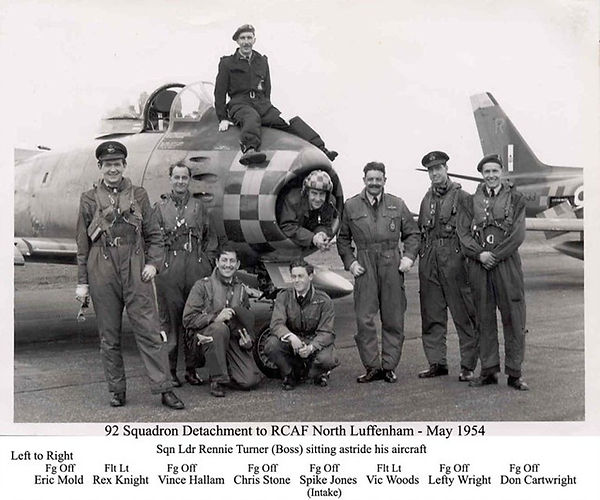
Squadron Leader L. G. “Rennie” Turner was the CO No. 92 Squadron (c.1952–Jan 1955) and therefore should be included as a King Cobra.
He served as Commanding Officer of 92 Squadron during its early-to-mid 1950s Sabre era. Posted from the Central Flying Establishment to replace Squadron Leader Jagger, Turner led 92 Squadron during the conversion to Canadair Sabre Mk F.4s at RAF Linton-on-Ouse. Photographic captions and unit histories associate him with Sabre airframes XD779 and XD769 (Linton, 1954–55). His tour as CO expired in January 1955 when command was handed to Squadron Leader R. W. G. Freer. (see below)
If you have any more information about Rennie Turner please do let us know and we will update this section.

Air Chief Marshal Sir Robert William George Freer, GBE, KCB, FRAeS, FRSA
Air Chief Marshal Sir Robert “Bob” Freer was a distinguished officer of the Royal Air Force whose career spanned forty years, encompassed both operational flying and high-level strategic command, and included service as Officer Commanding No. 92 Squadron RAF. His leadership during the Cold War era, his role in multiple theatres and commands, and his post-service contributions mark him as one of the RAF’s outstanding figures of his generation.
Early life and entry into the RAF
Robert William George Freer was born in Darjeeling, India, on 1 September 1923, and educated at Gosport Grammar School in England. He enlisted in the RAF (via training in South Africa) during the later stages of the Second World War, being commissioned as a Pilot Officer on 25 September 1943. His early wartime service was primarily as a flying instructor in South Africa and the UK, before transitioning into fighter operations.
Command of No. 92 Squadron and the fighter era
In January 1955 he was appointed Officer Commanding No. 92 Squadron, then equipped with the North American Sabre Mk F.4 and based at RAF Linton-on-Ouse. Under his leadership the squadron converted to the Hawker Hunter in April 1956 and deployed to Cyprus by December of that year. Freer’s tenure at 92 Squadron marked a period of transition for the unit from early jet fighters to more advanced types, and his influence on tactics and squadron culture was widely recognised.
Senior leadership and operational commands
Following his squadron command, Freer’s career progressed through key operational and strategic posts:
-
In August 1963, he became Station Commander at RAF Seletar in Singapore, just prior to the Indonesia–Malaysia Confrontation.
-
In April 1966 he was appointed Deputy Director of Defence Plans at the Ministry of Defence.
-
He was appointed Air Officer Commanding No. 11 (Fighter) Group in 1972, a key Cold War air-defence command in the UK.
-
In September 1975 he became Air Officer Commanding No. 18 (Maritime) Group, overseeing maritime air operations including Nimrod squadrons and rescue units.
-
In December 1978 he became Deputy Commander in Chief, Strike Command, managing one of the RAF’s largest operational command structures.
-
Finally, in January 1980 he was appointed Commandant of the Royal College of Defence Studies, a prestigious post shaping senior UK and allied military leadership. He retired from the RAF on 3 April 1982.


Honours, style and legacy
Freer’s decorations and honours reflect the breadth of his service:
-
Knight Commander of the Order of the Bath (KCB) – awarded 11 June 1977.
-
Knight Grand Cross of the Order of the British Empire (GBE) – awarded 13 June 1981.
-
Fellow of the Royal Aeronautical Society (FRAeS), Fellow of the Royal Society of Arts (FRSA).
-
Queen’s Commendation for Valuable Service in the Air (earlier in career).
Freer was known for his “collegiate style” of leadership, his calm under pressure and his personal flying ability well into his later years. Anecdotes record that even in his eighties he flew inverted runs in a Bulldog aircraft.
In retirement he held director and non-executive positions in private industry (e.g., Rediffusion, Pilatus Britten-Norman) and contributed to military and charitable organisations including the RAF Lawn Tennis Association and the Sports Council.
He died on 15 January 2012, at home in Farnham, Surrey, England.

Brian Mercer was a prominent RAF fighter pilot and aerobatic team leader during the 1950s and early 1960s. He achieved distinction as the leader of the famed display formation for No. 92 Squadron (RAF) known as the “Blue Diamonds”, having previously served with No. 111 Squadron (RAF) “Black Arrows”.
Born in the mid-1930s (exact date not publicly cited), Mercer entered the Royal Air Force and served as a fighter pilot during the early jet age. His flying career encompassed frontline squadrons equipped with early jet fighters during the Cold War era. In 1960 his name appears in the New Year’s Honours list as Squadron Leader Brian Patrick William Mercer (Service Number 59551), awarded the Air Force Cross (AFC).
As the commanding pilot of 92 Squadron’s Blue Diamonds display team, Mercer led the unit in a distinctive blue-painted Hunter formation aircraft scheme in 1961. The squadron deployment included international displays — notably at Mehrabad Airport, Tehran — and Mercer is credited with introducing new sequences into the team’s repertoire, building on his earlier display experience with No. 111 Squadron.

After his RAF service, Mercer went on to a civilian career and authored a book titled “Black Arrow Blue Diamond – Leading the Legendary RAF Flying Display Teams”, published in 2006, which recounts his RAF flying experiences and leadership of aerobatic teams.
Squadron Leader Mercer is remembered for his role in the transition of RAF fighter-squadron culture from wartime experience into the jet-age display era, and for his leadership of one of the RAF’s iconic post-war aerobatic formations.
Air Commodore John "Mitch" Mitchell, AFC, CBE
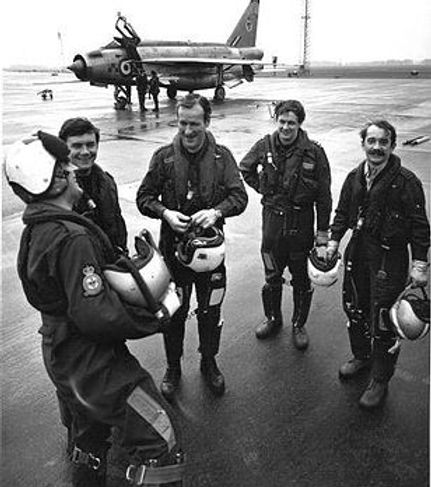

Air Commodore John “Mitch” Mitchell was a distinguished Royal Air Force fighter pilot and senior officer whose career spanned the dawn of the jet age into high-performance interceptor operations and senior leadership. His service with No. 92 Squadron as Commanding Officer, his pioneering work on the English Electric Lightning, and his later staff and command roles mark him as one of the RAF’s most accomplished post-war fighter leaders and quite simply one of the nicest men you could ever wish to meet. He was as popular with everyone who ever met him or worked with him, or for him, or just knew him, on the day he died than at any time in the past. He was fabulously supported by his wife Wendy, who is an equally extraordinary person. They were a formidable couple but only in just how lovely they both were (and Wendy still is).
Early life and Entry into the RAF
John Mitchell was born on 24 November 1930 in the United Kingdom. After attending flying training in Southern Rhodesia (in 1949) where he flew Tiger Moths and Harvards, he was commissioned in the RAF and went on to fly jet aircraft such as the Vampire and Meteor. His early career saw him qualify as a Qualified Flying Instructor (QFI) at RAF Cranwell in the mid-1950s, and he served tours flying Meteors at RAF Ahlhorn and RAF Church Fenton.

The Lightning era and conversion duties
In 1961 Mitch transitioned to flying the English Electric Lightning, becoming involved in advanced trials including air-to-air refuelling and high-altitude interception (notably testing against a Lockheed U-2 at over 70,000 ft). During this period he flew with No. 92 Squadron and then with No. 111 Squadron as a Flight Commander. Notably, he became the first pilot to log 1,000 hours on the Lightning.
Command of No. 92 Squadron
In August 1971, Mitch was appointed Officer Commanding (OC) No. 92 Squadron, based at RAF Gütersloh in Germany. He arrived during the squadron’s transition to the McDonnell Douglas Phantom FGR.2 air-defence aircraft, working alongside No. 19 Squadron. His leadership during this period was marked by innovation and operational readiness in the NATO front-line defence environment. Mitchell also embraced squadron heritage and symbolism: he is credited with adopting the “King Cobra” emblem on the fin of the squadron’s aircraft, signalling a spirited identity for No. 92.
Senior appointments and later service
Following his squadron command, Mitchell attended the Defence College at Latimer and then served as Station Commander at RAF Wildenrath in Germany. He later held senior ground command and staff roles including Director of the Air Defence Environment Team at the Ministry of Defence (MOD), and Military Adviser to the Ministry of Defence for Kuwait. He was decorated for his service with the Air Force Cross (AFC) and awarded the Commander of the Order of the British Empire (CBE).
He retired from active RAF service as an Air Commodore in 1984.
Style, legacy and honours
John’s career reflected a blend of skilled fighter-pilot credentials, technical development (Lightning trials) and Cold War operational leadership. His nickname “Mitch” indictes the approachable command style, which he carried thorugh to more than two decades as Chairman of the 92 Squadron Assocation.

Terry Kingsley, Pete New, John Mitchell, Rod Sargeant, Dave Ligget
Honours included:
-
Air Force Cross (AFC)
-
Commander of the Order of the British Empire (CBE)
-
Numerous other service medals and commendations.
His legacy includes the strengthening of No. 92 Squadron’s jet-age fighter identity, leadership of high-performance aircraft development, and bridging the era of Meteor and Lightning into Phantom operations. He passed away on 25 July 2024, aged 93.

Five King Cobras, Five Cobra Squadron Commanders, Paddy Hine, Joe Gilbert, Ed Durham, Black Fergusson, John Mitchell
Selected timeline:
Year Event
-
1930 Born 24 November
-
1949 Flying training in Southern Rhodesia
-
1961 Transitioned to Lightning; first pilot to 1,000 hours on Lightning
-
August 1971 Became Officer Commanding No. 92 Squadron, Germany
-
1977-80s Senior staff & station command roles (MOD / Germany)
-
1984 Retired from RAF as Air Commodore
-
25 July 2024 Died aged 93


Gotcha! Surprise party for Mitch's 92 birthday. It was a great turnout from those that loved and admired John, it was also a bloody good party with super speeches and much reminiscing. We miss you John!

Mitch's 92 birthday with fellow King Cobras and two ex Squadron Commanders, Rick P-E, Paddy Hine and Ali Mckay
Chris Bruce was a leading RAF fighter pilot and commanding officer of No. 92 Squadron during the Lightning era in the 1970s.
He may be unique as a Cobra in having served as a regular Squadron member, a Flight Commander AND the Squadron Commander. Brian Kingcome was all three but only Acting Squadron Commander when Roger Bushell was shot down. Not bad company to be in Chris!
Chris is remembered by former squadron members for his steady leadership on the NATO front line in Germany and for fostering high standards of operational readiness, and for spearheading one of 92 Squadron’s distinctive Lightning display teams.
Early career and rise to senior pilot
Public squadron narratives show Chris Bruce serving as an operational flight commander with 92 Squadron in the late 1960s / early 1970s and returning to the unit as its commanding officer in the early 1970s. He flew frontline interceptors (the English Electric Lightning) during a period of intense Cold War air defence operations in Germany, qualifying and instructing other pilots as part of the squadron’s high-tempo programme. These accounts emphasise Bruce’s practical experience as a flight leader and his reputation among junior pilots for calm, effective leadership under pressure.

Command of No. 92 Squadron (August 1973 – c.1975)
In August 1973 the squadron record marks the formal handover of command from the legend that was John “Mitch” Mitchell to Wing Commander Chris Bruce — an event celebrated by the unit and noted in the squadron dining-out. As OC, Bruce led 92 Squadron while it operated Lightning fighters from RAF Gütersloh, Germany, balancing the everyday demands of NATO air defence with the esprit de corps and ceremonial obligations of a storied squadron.
The Lightning display teams — “Green Marrows”
Under Bruce’s leadership 92 Squadron fielded an unofficial Lightning formation display team of five aircraft nicknamed the “Green Marrows”. The team performed at major station open days and public events (for example, RAF Gütersloh and RAF Wildenrath open days in mid-1975), flying tight formation sequences that showcased both pilot skill and maintenance excellence. Contemporary squadron accounts and the "A Cobra in the Sky" squadron history specifically name Wing Commander Chris Bruce as the leader of this team. The display work helped raise the squadron’s public profile and provided a morale boost for air and ground crews alike.
Command style and squadron life
Squadron histories and reminiscences portray Bruce as a professional commanding officer who combined operational focus with a keen sense of squadron tradition. He appears in multiple anecdotal passages — from routine flying incidents and social events to the management of detachment operations — showing that his tour encompassed both the quotidian demands of a frontline fighter unit and the high-visibility tasks of representing the RAF at public events. The unit record notes his involvement in a range of exercises, integration meetings with allied units, and the mentoring of young pilots newly converted to the Lightning.
Later service and final years
Public 92 Squadron material records Wing Commander Chris Bruce handing over command in the mid-1970s (the squadron narrative shows subsequent COs from late 1975). Separate forum and association notes indicate that Air Commodore Chris Bruce (the same officer referenced in squadron histories) later held senior RAF appointments — for example as Station Commander at Boulmer — and that he passed away on 27 December 2012. These later details are less extensively documented in open sources but are referenced by RAF associations and veteran forums.
Assessment and legacy
Chris Bruce’s time in command of 92 Squadron coincided with an era of rapid technological and tactical change: the Lightning was a high-performance, demanding interceptor; NATO air defence posture required near-constant readiness; and public display work added an extra layer of responsibility. Bruce’s leadership during the Lightning era — especially his visible role with the “Green Marrows” display team — left a lasting impression in the squadron’s post-war history. Veterans’ recollections emphasise his effectiveness as an operational leader who valued both flying excellence and squadron morale.
Selected timeline (approximate, compiled from squadron sources)
-
Late 1960s–early 1970s — Chris Bruce serves as a senior flight commander with 92 Squadron (Lightning era).
-
August 1973 — Assumes command of No. 92 Squadron (Wing Commander Chris Bruce).
-
1974–1975 — Leads the 92 Squadron Lightning formation display team (“Green Marrows”), performing at station open days including Gütersloh and Wildenrath.
-
Late 1975 — Departs squadron command; succeeded by the next OC (records show change of command in squadron history).
-
Post-squadron career — Later senior RAF appointments and association activity; reported death 27 Dec 2012.

Mitch handing the reins to Chris in August 1973
Air Commodore Rick Peacock-Edwards, (RPE) AFC, CBE

Rick and Joe Gilbert flying the Tornado F3

A young Rick P-E with The Princess Royal, Princess Anne, at a dining-in night. Oh what might have been (we think he is far better off with Tina!)


Rick flew this T4 with No 231 OCU’s ‘Mr Canberra’, Sqn Ldr Terry Cairns (right), and another of the unit’s pilots.
Air Commodore Rick Peacock-Edwards is a distinguished former Royal Air Force fighter pilot and senior officer whose career spanned over three decades, covering the high-intensity Cold War era, the transition to modern jet fighters, and senior leadership roles in the RAF and defence industry.
Early life and RAF entry
Rick Peacock-Edwards was educated in South Africa (Michaelhouse and University of the Witwatersrand) before joining the RAF in 1965. He came from an aviation family — his father, F/O S. R. Peacock-Edwards, was a Battle of Britain pilot.
From the outset, he specialised in fighter aircraft, accumulating over 1,000 hours on front-line types including the English Electric Lightning, McDonnell Douglas Phantom, and Tornado F2/3 — a rare achievement
Operational and command experience
During his RAF career Rick Peacock-Edwards played key roles in both flying and leadership:
-
He introduced and commanded the Tornado F2/3 Operational Conversion Unit, bringing the type into RAF service
-
He served as Deputy Director Air Defence at the Ministry of Defence (1989-90), and from 1990-92 commanded the front-line Tornado base at RAF Leeming
-
In the early 1990s he held senior posts overseas, including Assistant Air Attaché at the British Embassy in Washington, before promotion to Air Commodore
-
He was MOD Inspector of Flight Safety for the RAF from 1994 -97
-
His final active RAF appointment was as Director of the Eurofighter Typhoon programme at the MOD (mid-1990s)
Honours, legacy and post-RAF career
Rick Peacock-Edwards was awarded the Air Force Cross (AFC) in 1987, and appointed Commander of the Order of the British Empire (CBE) in 1993
After retiring from full-time RAF service in 1999, he worked in the defence and aviation industry: first with General Dynamics UK (Director of Government Relations/Military Advisors), then as Managing Director of Vector Flying Training Services (2004-07)
Beyond his professional career, Peacock-Edwards has been an active figure in the aviation community: Past Master of the Honourable Company of Air Pilots, Chairman and President of the Historic Aircraft Association, Chairman of the General Aviation Safety Council (GASCO), President of Air Search UK, and a strong supporter of organisations such as Orbis where he is an Ambassador
From 2009 -19 he served as a Trustee and Vice-Chairman of the RAF Club. He also founded two entrepreneurial ventures, In Command Ltd, and Battle of Britain Tours, he has had a long involvement with air displays, as a display pilot, as a member of Flying Control Committees, and as a Flying Display Director. He has had a long association with the Imperial War Museum, Duxford. He is the author of three books, his autobiography, Rate of Climb (2020), Gnat Boys (2023), and Teddy Peacock-Edwards, Battle of Britain pilot and World War 2 Ace (2026)
Personal and Family Life
Rick Peacock-Edwards has been married to Tina, an ex-RAF Air Traffic Controller, since 1974. They have three children (2 girls and a boy), and 3 granddaughters
Selected timeline
1965 Joined Royal Air Force
Late 1970s-80s Over 1,000 hours on Lightning, Phantom, TornadoF2/3, Gnat
1989-90 Deputy Director Air Defence, Ministry of Defence
1990-92 Officer Commanding, RAF Leeming
1992-94 Deputy Commander RAF Staff & Assistant Air Attache USA
1994-97 RAF Inspector of Flight Safety
1987 Awarded AFC
1993 Appointed CBE
1999 Retired RAF service
2004-07 Managing Director, Vector Flying Training Services
Summary
Air Commodore Rick Peacock-Edwards represents the classic fighter pilot-leader of the late 20th century; exceptional flying skill, operational command of front-line units, and senior strategic roles in defence programmes. His career bridged the analogue era of air defence into the jet age of the Tornado and Eurofighter platforms.
On a more personal note, all fellow Cobras know what a superb chap Rick is, he is always great fun, fond of the occasional glass of red wine and is incredibly generous, more importantly with his time as well as his hospitality. We are hounoured that after a stellar career, spaning so many Squadrons and flying experiences, Rick has always been unequivocal in saying it is 92 that stands head and shoulders above any one or anything else.

92 Sqn Summer 1968. L-R Paddy Pyper, Dave Matthewson, Sandy Davis, Colin Armstrong, Hoppy Richardson, Doug Aylward, Paddy Roberts, Ian Thomson (OCB), Chris Greaves (JENGO), Robbie Robinson (OC 92 In Cockpit), Pete Whitbread (SENGO (Des), Mal Kent (SENGO), Chris Bruce (OCA), John Rooum, John Wolff, Graham Pritchard, RPE, Jack Glass, Jerry Bowler

92 Sqn MPC, RAF Valley, 1968. L- R in photo: Chris Greaves (JENGO), Ian Thomson (OCB), Dave Matthewson, Graham Pritchard, Robbie Robinson (OC 92), Rich Rhodes (IWI),Colin Armstrong (who died in a Red Arrows mid-air accident a few years later), Jonathon 'Paddy' Pyper, Rick Peacock-Edwards.

92 Reunion 2025, Dave Gledhill (Chairman), Wg Cdr Sam Williams, Current OC 92, RPE (President) with Squadron Standard in RAF Club.

Another 1000 hours clocked up for Rick, , the fourth on RAF Fast jets including the Lightning, Gnat, Phantom and finally the Tornado F2/3. A stellar and quite rare achievement.

The RAF's pin up boy (Euan Black) Rick is also in this photo

Rick and AVM Ken Hayr flew in the first two Tornado F2s to be delivered to the RAF on 5 Nov 84, Bonfire night. Whoever said Bonfire Night is where the F2/3 should have gone was very unfair! By the time it was withdrawn from service it was a hugley capable platform.
Click image for article on RPE in Aero magazine

92 Squadron RAF Germany Inter Squadron Squash Champions 1969 and 1970

Ali and the ever patient Coreen


Ali with his driver the late SAC Daz Kerr, who was rightly rewarded for his outstanding service to Ali with a trip in the back seat of the Phantom that included low level and supersonic flight (not at the same time)

Ali McKay was a senior Royal Air Force officer and front-line fighter pilot during the Cold War who flew the English Electric Lightning with 92 Sqiuadron and later the F-4 Phantom again with the Cobras as a Flight commander, at the time when the Squadron was transitioning from the Lightning to the Phantom. He commanded No. 56 (Fighter) Squadron and served as Station Commander at RAF Wildenrath making him associated with 92 Squadron for a third time, not unique (see Chris Bruce and Brian Kingcome) but this puts him in esteemed company which is richly deserved. After leaving uniform he moved into senior roles in the retail sector, including directorships with the John Lewis Partnership.
Ali was reverred by everyone who ever worked with or for him. He was a true Fighter Leader with a "work hard play hard attitude" that forged incredibly loyal bonds with those he led. Known for his hilarious pranks when he was a young Lightning Pilot, (letting off a fire extinguisher at the 19 Squadron top table with all the ladies in thier finery was just one example) he was still incredibly professional in the air and was selected early on to become a Lightning IWI, (an Interceptor Weapons Instructor). Make no mistake this would make him a real Top Gun if ever there was one. Shortly after Ali transitioned to the F4 Phantom he was promoted to Squadron Leader and a decision was made that he should complete the Phantom QWI course ( A full six month course for those very experienced on type ) Having just completed the OCU and with just over 50 hours on the F4 he faced a demand that would have been beyond most mere mortals
In the past, when the RAF was a significant fighting force and there were a lot of flying squadrons, there were many officers who took on senior leadership roles, not all of these individuals you would unhesitatingly say you would gladly follow to war, potentially to your own demise. Ali McKay was definitley one of those extraordinary leaders who you would follow anywhere. He is also quite simply, a top bloke, great fun, sharp as a tack and unstintingly loyal to his friends and his old Squadron. A true King Cobra but also a family man and like many successful men from that period, Ali was supported by the equally extraordinary (and patient) Coreen. There can be no doubt that many women of the time sacrificed their own careers to support their husbands. Ali could not have done the things he did, without the amazing support of his family. The ever patient Coreen was woken up in the early hours one morning by loud music and what sounded like an intruder rummaging noisily through the drinks cupboard. She went down to find Ali much the worse for wear, preparing gin and tonics for another pilot colleague and himself. Assuming he had been in the" night flying” bar most of the night/morning she was very very angry, particularly as she had a long nursing shift due later at Grimsby hospital and needed her sleep. But she then enquired why he was wearing a fluffy green bunny suit. She had not been informed that he had ejected out of his burning Lightning and spent a few hours in the North Sea. Coreen forgave him his indiscretion. It wasn’t to be his last !
Early career and fast-jet flying
Ali came through the RAF officer and pilot training system in the post-war / Cold War era and established his reputation as a Lightning pilot — a role that demanded exceptional airmanship and quick decision-making in high-performance interceptors. In the 1970s and early 1980s Ali was heavily involved in front-line fighter units operating from RAF stations in Germany (Gutersloh and Wildenrath) as part of NATO’s air-defence posture.
Command of No. 56 Squadron (the “Firebirds”)
Ali served as Officer Commanding, No. 56 (Fighter) Squadron, one of the RAF’s more famous frontline Phantom squadrons. This appointment placed him in charge of a full fighter squadron, responsible for operational readiness, training, NATO scramble tasks and overseas detachments. As CO of 56 Squadron McKay would oversee sustained intercept readiness and large-scale exercises, and he is referenced in first-hand accounts by veterans who served on Phantom deployments under his command.

Work hard, play hard

Never far from the bar! But clearly in need of a bit more training on how to pull a proper pint!


The boys dropped flour bombs and toilet rolls on the mess, they were very pleased with the results and the reprobate on the right was celebrating with a beer, but the Station Commander was not as impressed and ordered them to clean up their mess which necessitated Ali being dangled

from a Wessex to retrieve the offending
articles! The other pictures to the right show Ali's more serious side!
Station Commander — RAF Wildenrath
Following squadron command, Ali was promoted again, to Group Captain. He was then offered the fabulous opportunity to be re-assocatied with his first love, The Cobras, by becoming the Station Commander of RAF Wildenrath in 1986. This eventful period, was marked by huge success for the station and enormous fun with the entire base and tragedy. Ali notes his saddest time was dealing with aftermath of the horrific IRA attacks on station personnel in Roermond.
To say Ali was an energetic station commander would be an understatement. He was as happy in the Sergeant's or Junior Ranks Mess as he was in the Officer's mess. He was reverred throughout the station. He has been heard to say that one of his proudest moments was in a Taceval when he heard even the most junior of personnel working their nuts off and urging their comrades to do their utmost to get a succesful outcome. When real enthusiasm filters to the most junior of service personnel, you know you are doing something right! Ali even managed to complete a notable late-service conversion sortie in the Pembroke in March 1989 at Wildenrath, a detail that typifies his hands-on style of leadership.
Honours, leadership style and operational reputation
If anyone deserved formal recognition for outstanding flying ability and leadership it was Ali and he was recommended for such on two separate occasions, once as a Flt Lt IWI on Lightnings and then again on 92, but this time on Phantoms. These recommendations resulted in well deserved Queen's Commendations for Valuable Services in the Air and they were a clear demonstration how much Ali loved 92 and how much he wanted to put in. Everyone who knew Ali, from the lowest ranks to the highest, was convinced he was destined for the very top and he was universally acknowledged as having had an outstanding tour at RAF Wildenrath. What we didn't know, however, was this rise to the top would be with the John Lewis Partnership in "civvy street" and not with the RAF as he chose to leave the service shortly after leaving Wildenrath. Those people he worked with in the Partnership were the beneficiaries of the RAFs loss and he led them with as much pride and passion as he had done througout his long and successful RAF career.
It is intersting to note that public records describe Ali "as a pragmatic, hands-on leader who combined operational competence with an ability to represent the RAF publicly. His command appointments (squadron CO and station commander) underscore a career built on operational flying, excellent training, and base management on NATO's front line ." Not a bad summary.
Civilian career: retail leadership and board roles
After leaving the RAF, Ali moved into commercial life and senior management in the retail sector. Ali held multiple director appointments with The John Lewis Partnership. These public records show him acting at director level for the Partnership and associated businesses between 1992 and 2007, confirming a substantial second career in retail governance. He entered full time retirement having served as deputy Chairman of JLP. No one was surprised by this epic rise to such lofty business heights, except perhaps for the young RAF serviceman who saw Ali working behind a John Lewis Store cash till not long after he has retired from the Air Force. How the mighty have fallen, the young man must have thought, little did he know it was part of an excellent tranining programme that exposed Ali to every part of the business, starting at the very bottom and finishing at the very top.
Later life and legacy
Ali retained connections with the RAF and specifically with 92 Squadron Association after his service. He took over the Chairmanship of the Association from John Mitchell, a tough act to follow and Ali did this, as he did all the jobs he took on, superbly well. Ali is still a regular attendee of 92 Squadron reunions and despite leading another almost as famous Fighter Squadron (56 Squadron) remains a Cobra through and through.
Ali is remembered by all who know him for his inspirational leadership, a superb operational focus, and for helping to sustain high performance standards during a demanding period for NATO air defences.
Selected timeline (summary)
-
c.1970s–early 1980s — Lightning pilot and senior flight/pilot roles in front-line RAF units.
-
c.1979–c.1984 — Officer Commanding, No. 56 (F) Squadron (Phantom era).
-
1980s (mid–late) — Station Commander, RAF Wildenrath (Group Captain).
-
1990s–2007 — Director / senior executive roles in retail (John Lewis Partnership; Waitrose; other directorships listed at Companies House ending his time at JLP as the deputy Chairman
-
Chairman of the 92 Squadron Association


Ali with is very close pal, Alan Reynolds at yet another "bad taste' party. Ali describes his great friend as the most incredibly talented back seater he ever flew with, and they are still very close friends.


Taff debriefing his last one versus one air combat sortie.

Taff doing what he does best, leading the drinking and more importantly the singing. What would we do without a Welsh voice in the Squadron sing-a-longs!
Service: Royal Air Force
Squadron: No. 92 (East India) Squadron
Era: 1970s – 1980s
Aircraft flown: English Electric Lightning; McDonnell Douglas Phantom, Convair F106 Delta Dart
Postings: RAF Gütersloh, RAF Wildenrath
Full name: Geraint Oswyn Harries
Early career and training
Geraint Oswyn “Taff” Harries joined the Royal Air Force during the Cold War period and qualified as a fighter pilot and being selected to fly the English Electric Lightning. He had entered the service during an era of rapid technological and tactical development. By the early 1970s he was flying high-performance interceptors with No. 92 Squadron RAF, the premier front-line fighter unit stationed in Germany as part of NATO’s Second Allied Tactical Air Force.
Service with No. 92 Squadron
Taff served on the squadron in two main periods — 1971 to 1974 and 1986 to 1990. His early tour coincided with the squadron’s time at RAF Gütersloh, Germany, where 92 Squadron maintained a constant quick-reaction alert role within NATO air defence.
Taff was selected to undertake an exchange posting in the United States of America flying the F106 Delta Dart an all-weather interceptor aircraft designed and produced by the American aircraft manufacturer Convair.
The squadron history recorded in "A Cobra in the Sky", references his arrival following the departure of another officer, marking his welcome with a characteristic 92 Squadron initiation — a light-hearted tradition observed when new pilots joined the tight-knit team.
Leadership and reputation
On his return to 92 Squadron at RAF Wlidenrath flying hte F4 Phantom Taff served as A Flight Commander alongside the irrepressible Brian Clarke, who led B Flight. Those who served on 92 Squadron during Harries’s era describe a squadron culture built on professionalism, camaraderie, and deep loyalty — qualities that “Taff” Harries embodied. His Welsh heritage and personable nature made him a memorable member of the unit, contributing both operational skill and good humour to squadron life.
His long tenure and repeat postings reflect the RAF’s confidence in his leadership and technical ability, especially in the demanding environment of NATO Germany during the latter Cold War decades.
Later life and legacy
Following his RAF service, Taff became a civilian flying instructor and has maintained connections with the RAF community through the 92 Squadron Association, and attending reunions. His dual service tours, spanning nearly twenty years apart, made him a link between two distinct eras of the squadron’s history — from the Lightning’s raw power in the early 1970s to the Phantom’s advanced systems in the late 1980s.
Taff’s career represents the steady professionalism of RAF fighter pilots who safeguarded Western Europe during a period of high tension, balancing operational readiness with the esprit de corps that defined the RAF’s fighter squadrons.


Black qualified as a helicopter pilot but great to see he is wearing his 92 Squadron badge


I'm a paragraph. Click here to add your own text and edit me. It's easy.
Air Marshal Graeme Alan Robertson, nick-named “Black”, is a distinguished retired officer of the Royal Air Force whose career spanned nearly 35 years in flying, staff and command appointments. His service included fighter squadrons, station commands, senior NATO-related posts and a transition to industry in the defence sector. His book Fighters in the Blood and subsequent publications reflect his strong engagement with aviation heritage and leadership. pen-and-sword.co.uk+1
Early Life and Entry into the RAF
Black was born on 22 February 1945 in Woodford, Essex. He was educated at Bancroft’s School (Woodford-area) and, after finishing school, entered the RAF College Cranwell in 1963. Following three years of training he earned his wings, and his first operational posting was with No. 8 Squadron in 1968, flying the Hawker Hunter in Bahrain.
From early on, Black showed a wide flying interest: he flew a number of the RAF’s frontline fast jets (including the Phantom) and also qualified as a helicopter pilot.
Squadron Command and Operational Leadership
In 1982 Black was appointed Officer Commanding (OC) of No. 92 Squadron RAF, the renowned fighter squadron based in Germany and operating the McDonnell Douglas Phantom interceptor. His time with 92 Squadron is described by him as a highlight of his career.
He then commanded No. 23 Squadron RAF in the Falklands in 1984, served as Station Commander at RAF Wattisham from 1985, and subsequently held the role of Deputy Commander RAF Germany in 1991.
In 1993 he was appointed Air Officer Commanding (AOC) No. 2 Group RAF; his final RAF appointment was as Chief of Staff and Deputy Commander-in-Chief at RAF Strike Command in 1996. He retired from the RAF in 1998.
Style, Honours and Post-Service Career
Black earned a reputation for operational excellence, an uncompromising leadership style and a strong commitment to the RAF’s heritage. His honours include Commander of the Order of the British Empire (CBE) and his fellowship in the Royal Aeronautical Society (FRAeS) and the Royal Society of Arts (FRSA).
After leaving RAF service he joined BAE Systems in March 1999 and later established his own consultancy. He is also a published author and speaker on aviation and leadership topics.
Selected Timeline:
Year Event
1945 Born 22 February, Woodford, Essex
1963 Entered RAF College Cranwell
1968 Operational posting to No. 8 Squadron (Hawker Hunter)
1982 OC No. 92 Squadron RAF
1984 OC No. 23 Squadron (Falklands)
1985 Station Commander RAF Wattisham
1991 Deputy Commander RAF Germany
1993 AOC No. 2 Group
1996–98 Chief of Staff/Deputy C-in-C Strike Command; retired 1998
Legacy
Air Marshal Graeme “Black” Robertson’s career embodies the transition of the Royal Air Force through the Cold War era — from supersonic interceptors on the German frontier, through station leadership and NATO staff roles, to the institutional and strategic levels. His contributions to aviation heritage, his writings and his role in mentoring and leadership have ensured that his influence extends beyond his operational service.
His book Fighters in the Blood gives an insider’s view of both his own career and the broader RAF culture, underscoring his role as an aviator and thinker.


I'm a paragraph. Click here to add your own text and edit me. It's easy.
Work in progress


Blaster sharing a joke with Her Majesty the Queen, Queen Elizabeth II - he says he cannot remember what made everyone slip in to a fit of the giggles
Air Vice-Marshal Brian 'Blaster' Bates was a senior Royal Air Force officer and air defence navigator whose career spanned the Cold War and post-Cold War eras. A highly experienced fast-jet aviator and Qualified Weapons Instructor (QWI), he accumulated some 3,000 flying hours on the F4 Phantom and Tornado F3. He enjoyed a full and varied career in the RAF, and went on to fill a broad range of senior operational and staff appointments across Defence, both at home and abroad.
Early life and entry into the RAF
Blaster comes from a military family and was born in Nicosia, Cyprus on 15 June 1957. He was educated at Wellington School in Somerset and joined the RAF on the University Cadetship Scheme. After graduating from Portsmouth Polytechnic in 1978 with a degree in Economics, he completed Initial Officer Training at the RAF College Cranwell and navigator training at RAF Finningley and RAF Brawdy before converting onto the F4 Phantom in the air defence role.
Operational flying and Cold War service
On graduating from the F4 Phantom Operational Conversion Unit at the end of 1980, Blaster was posted to 43 Squadron at RAF Leuchars and spent the next 10 years on frontline squadrons, amassing some 2,300 hours on the F4 Phantom. He completed the QWI course after his first operational tour and went on to serve as a QWI on 56 and 23 (in the Falkland Islands) squadrons before joining 92 Squadron at RAF Wildenrath, where he enjoyed over 3 years as the QWI(Leader).
Blaster's operational flying experiences during the Cold War period include myriad Quick Reaction Alert scrambles, and the interception and shadowing of an array of Soviet aircraft. Indeed, he earned his '10 Bear Badge' in his first 2 years on 43 Squadron. He was deployed to the Falkland Islands on 3 separate occasions and was scrambled to shadow Argentinian aircraft in the South Atlantic.
Notable operations and command appointments
Following a 6-month course in 1997 to convert to the Tornado F3, Blaster commanded Operations Wing at RAF Leeming, a frontline Tornado F3 base. He was then posted, on promotion, to HQ Strike Command to take up the double-hatted appointment of Group Captain Corporate Communications and Head of the RAF Presentation Team, but was plucked from this post after just 10 months to become Commander British Forces in the Gulf. In this 6-month deployed role, he commanded British forces in the region supporting the US-led mission to enforce the no-fly zone over southern Iraq.
On completion of the Higher Command and Staff Course in 2002, Blaster returned to RAF Leeming as the Station Commander, quickly regaining his Combat Ready status on the Tornado F3 and flying regularly with XI and 25 squadrons. Early on in his 2-year tenure, he was again deployed to the Middle East to command the RAF's largest Deployed Operating Base during the build-up and combat phases of the second Gulf War.
Style, instruction and leadership
Blaster has extensive experience as an instructor and a track record of success in motivating people to give of their best. Highly professional, but with an easy-going manner, he has an inclusive leadership style and extensive experience in building and leading high performing teams. While serving as the QWI(Leader) on 92 Squadron, he showed that rare ability to command the respect and confidence of his juniors whilst at the same time mixing effortlessly with them and cultivating a sense of fun, both professionally and socially.
Honours, later life and civilian activity
Blaster was appointed Commander of the Order of the British Empire (CBE) in 2005. His honours also include the Iraq Medal with Clasp and the General Service Medal, as well as Queen Elizabeth II Gold and Diamond Jubilee medals.
After retiring from the Service in 2012, he joined Ultra Electronics as a Divisional Marketing Director and later worked as an independent consultant in the Aerospace and Defence sector.
Selected timeline
-
1980-1990: Operational F4 Phantom navigator/QWI with 43, 23, 56 and 92 squadrons
-
1994-95: PSO to AOC 11 Group
-
1998-2000: OC Operations Wing, RAF Leeming
-
2001: Commander British Forces in the Gulf
-
2002-04: OC RAF Leeming (including 3 months in command of a Deployed Operating Base during the second Gulf War)
-
2004-05: Assistant Director Strategic Plans, Ministry of Defence
-
2005-06: Chief of the Defence Staff's Liaison Officer to the Chairman of the US Joint Chiefs of Staff in Washington DC
-
2006-08: Director Joint Capability, Ministry of Defence
-
2008-09: Assistant Chief of Staff Capability, HQ Air Command
-
2009-12: Senior Directing Staff (Air), Royal College of Defence Studies


A classic shot of Balster from the 92 Squadron diary, clearly on detachment in Cyprus, the caption says

A typical photo of Blaster the QWI Leader from the Squadron diary obvioulsy taken on detachment in Cyprus.
Viewers of this site need to know that Blaster was a highly competent aviator and consummately professional but with a fantastic sense of humour.
Work in progress
I'm a paragraph. Click here to add your own text and edit me. It's easy.
Perhaps one of the best-known Cobras of recent years is a certain ginger lad from Hastings who has had a remarkable flying career over 40+ years and who is still flying Spitfires today. Antony Felix ‘Parky’ Parkinson flew the Phantom, Tornado F3, Hawk and Typhoon in RAF service, reaching 1000 hours plus in each, including becoming the first ever to achieve the milestone in the Typhoon. He is likely the leading current “high time” Spitfire pilot in the world, having recently clocked his 2,500th hour. This alone is an outstanding achievement but Parky’s logbook also reflects an exchange tour flying the F16, Two years as the F3 solo display pilot, four years in the Red Arrows, eleven years flying Spitfires and Hurricanes for the BBMF. What a git. You will find numerous fawning articles on spotters’ websites only too keen to blow smoke up his ginger arse if you’d prefer a formal version of events. However, this brief article will focus on Parky’s pivotal time as a Cobra early in his career where he provided an inkling of the once-in-a generation fighter pilot he was to become.


Parky with his good friend and "hero" Geoffrey Wellum DFC
Parky joined 92 Sqn at Wildenrath in November 1989 after surviving relatively unscathed from his first tour on Tremblers. Parky had impressed at Leuchars and acquired an early reputation as a talented pair of hands and excellent prospect in the cockpit. He had also indicated a particular bent for the air display circuit when he successfully parked a Phantom in a corn field at the end of Biggin Hill runway – albeit it probably says more about the flying supervisor that sent a young JP to deliver a heavy Delta-fit F4 to a civilian airshow runway on a Friday afternoon. More on air displays later in his career. Parky had already met many of his new squadron mates at a Cobras APC party in the bar in Akrotiri a few months prior to posting date. Unfortunately, his prospective new boss (Polly), possibly scarred by the Efti Jetty scandal (see Shaggy’s article), was less than delighted with the prospect of Parky joining his squadron after witnessing his exuberance in the bar. Fortunately, he was probably assuaged by the distinguished behaviour of his talented navigator who was also inbound to Wildenrath (or more likely because he’d be soon become the problem of the new Boss, Wing Commander Ken “Clackers” Claxton.)
Parky with the ever patient Mrs Parky "Annie" in Cobra colours and a cheeky moustache
As a seasoned second tourist at a time of heavy dilution across the F4 force, Parky rapidly settled into a middle-management role as deputy Flight Commander. The new boss Clackers remarkably was able to keep a straight face in Friday Execs one day when his Execs were all away so was faced with the reality of his new set of deputies instead (Parky, “Ricko” Offord and “Rolfie’ Dunne). Think Beavis, Butthead and a short cheeky chappy and you’d get the vibe. With a shock of bright ginger hair and a personality to match, Parky was hard to miss. Much to the initial chagrin of some established ‘wellard’ stick-monkeys, he quickly reinforced his reputation as a talented fighter pilot and one to beat (or avoid) during ACT.
A golden generation of Cobras emerged that demonstrably sent shivers through spines of Soviet Bloc squadrons facing them across the Inner German Border. Recently disclosed DDR documents revealed that Parky & his Cobra mates positively hastened the end of the Cold War through presence alone. This view was supported by archive Stasi material from observations of Parky’s stag weekend held in Berlin, via the British Military Train, when a large number of Cobras (and some Dolphin boys) demonstrated immense stamina, style, and power of recovery.

This was further reinforced (apparently) by a partially translated excerpt from Erich Honecker’s diary at the time of the fall of the Berlin Wall:
Ja, Ich know das economy ist gefucked und das volk are insisting on change but wir haben keine chance against der mighty Cobras, und jetzt haben die Karotte-top Parky, apparently ist er annoyingly gut. Fuck it, Ich quit!
Once the threat from the East dissolved, Parky and his Cobra chums were dispatched to Cyprus to defend the Eastern Mediterranean from Saddam Hussein’s aggression. Obviously, the Wildenrath Wing was the natural choice as the RAF’s premier Air Defence outfit to deploy directly to the Gulf but that would be a bad look politically as the UK had flogged the troubled Tornado F2 to the Saudis. Ho hum. The Squadron therefore quickly settled into a routine of QRA at Golf Dispersal, DACT or ADEX sorties for transiting air and surface forces, and occasional stress-releasing soirees in Limassol. Despite the realisation that every cocktail could be their last, the Cobras once again proved their resilience, and the population of Cyprus were able to sleep soundly in their beds (apart from those closest to Animal House).


Parky is also a talented musician, here he can be seen playing his invisible oboe, in which he is an expert, only exceeded by his playing of his pink oboe.

Parky is a keen golfer and what he lacks in talent he makes up for with his sartorial elegance on the course. Here he is seen with his partner in crime Rolfie "Tiger" Dunne, looking equally smart.

Parky has not been told that when playing waterpolo it is bad form to ride a crocodile in the game
Parky routinely displayed his air combat prowess in ACT/DACT and his innate simmering and barely-controlled Wellard aggressive qualities were also evident on the ground (twatting Shaggy with a tennis racquet for moving the entire contents of his room on to the lawn at Animal House and holding his blameless navigator in an armlock throughout a long taxi ride back from Limassol simply for asking for some quiet earlier in the day!). The message was clear, it’s a hard RV at Mulligan’s and don’t mess with Parky. His reputation as the consummate professional Fighter Pilot was also reinforced by having the lowest mess bill at the end of the Det. This was easily explained as he was tucked up early most nights studying the aircrew manual and improving his language skills with a slightly soiled publication with the unusual title ‘lesbiche gier anal’ sic. The language sounded jolly difficult whatever it was so all credit for his determined efforts for self-improvement.
Sadly, the ‘Peace Dividend’ truncated Parky’s time at Wildenrath and he soon moved on to the rapidly improving Tornado F3. His subsequent remarkable career has become a thing of legend and will prove to be impossible to replicate. Fellow Cobras of the time will recall a memorable period on 92 Sqn in which Parky was central to events. They/we will also (somewhat reluctantly) acknowledge that this entertaining (& frequently irritating) bloke was/is an absurdly talented pilot (the best I’ve flown with), and the most loyal of friends. Parky is a once-in-a-generation pilot and a King Cobra to be proud of!


Ever the professional, Parky forgoing his normal nocturnal reading for something mentally stimulating
Parky's last trip in an F4 delivering a 92 Jet back to Wattisham in 1991

Parky with his Cobra mates, Reggie Fairs, Rolfie Dunne, Ricko Offord and Shaggy Curtis at a mini Cobra reunion