
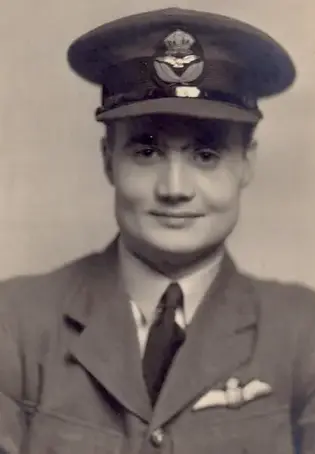
Group Captain Charles "Brian" Fabris Kingcome, DSO, DFC and Bar
Click on this picture of Brian to hear a great story retold by James Holland and Al Murray about Brian and Tony Bartley, it definitely sums up the spirit of 92 Squadron


Early Life and Entry into the Royal Air Force
Charles Brian Fabris Kingcome was born on 31 May 1917 in Calcutta, then part of British India. His family later returned to England, and he was educated at Bedford School.
In January 1936, Kingcome entered the Royal Air Force College at Cranwell as a flight cadet. During his training he was involved in a serious car accident that left him with double vision; doctors believed this impairment might prevent his flying career. However, after months of recovery, he rejoined his training and completed his course.
He was commissioned as a Pilot Officer on 30 July 1938 and posted to No. 65 Squadron at Hornchurch, just as the RAF was building up in the face of growing tensions in Europe. Hornchurch’s role in the defence of southeast England would place him at the forefront when war broke.

Wartime Service: Battle of Britain and Squadron Leadership
When the Second World War began in 1939, Kingcome served with No. 65 Squadron. He saw action in the Battle of France and later during the Dunkirk evacuation. Though these early operations were intense, his “kills” (enemy aircraft destroyed) came later.
In May 1940, Kingcome was posted to No. 92 Squadron, initially as a flight commander. The squadron was based at Biggin Hill among other stations, and was heavily engaged during the Battle of Britain. Kingcome frequently took temporary command of the squadron, and later in early 1941 he was appointed its full commanding officer. Under his leadership, 92 Squadron achieved what is described in several sources as one of the highest success rates of any squadron in that Battle.
During the Battle of Britain, he suffered a serious injury: in October 1940 his Spitfire was shot down after a combat engagement with Me109s. He bailed out, wounded, and was hospitalized. After convalescence, he returned to 92 Squadron in December 1940.
His combat successes grew through 1941. He was awarded the Distinguished Flying Cross (DFC) in 1940, a Bar to the DFC in 1941, reflecting his growing tally of victories and leadership in combat.
Higher Command, Wings and Campaigns
In 1942, Kingcome’s role expanded beyond single-squadron command. He took command of 72 Squadron and then, in mid-1942, became Wing Leader at Kenley. He also was involved with the Fighter Leaders School at RAF Charmy Down.
In May 1943, Kingcome was posted to Malta to lead No. 244 Wing, part of the Desert Air Force. From there he led several Spitfire squadrons through campaigns in Sicily and Italy. This period involved intense air operations supporting ground forces, dealing with enemy fighters and providing air cover in challenging Mediterranean weather and terrain conditions.
Following his command of 244 Wing, he was promoted to Group Captain—one of the youngest RAF officers to reach that rank during the war—while still in operational command roles. Later in the war he served in staff positions, including as Senior Air Staff Officer (SASO) in No. 205 Group, which oversaw heavy bomber operations. Despite being in staff roles, he continued to fly occasionally, including missions over Northern Yugoslavia with bomber crews.
Combat Record, Tactics, Awards and Approach
Brian Kingcome’s aerial victory record at the end of the war stood at:
-
Enemy aircraft destroyed: 8
-
Shared destroyed: 3
-
Probables: 5
-
Damaged: 13
Kingcome’s style was a mixture of boldness, well-practised Spitfire handling, and leadership by example. He was known to deputize frequently, take temporary command under difficult circumstances, and to keep operational flying long after many officers would have been moved to safer staff duties. His leadership was highly valued by his peers and his squadrons, particularly 92 Squadron, which he regarded with great affection.


Brian's decorations reflect his extraordinary service:
-
Distinguished Flying Cross (DFC) — 1940, for early combat achievements in the Battle of Britain.
-
Bar to the DFC — 1941, for further combat success and leadership.
-
Distinguished Service Order (DSO) — awarded in December 1942, recognizing his leadership as Wing Leader and for operational sorties including leading offensive sweeps, and his cumulative combat record.
Post-War Life, Later Career and Legacy
After the end of the war, Kingcome remained in the RAF, commanding No. 324 Wing (Spitfire wing) in Austria. He also took various staff posts. However, the strain of continuous operations had taken a toll on his health. In particular, he developed tuberculosis and other health issues. These eventually compelled him to leave RAF service in 1954. Though at the time of his invaliding out his substantive rank was Wing Commander, he was permitted to retain the rank of Group Captain in retirement.
In civilian life, Kingcome was resourceful and enterprising. He went into business with a former Battle of Britain comrade, running a London garage and car hire business. In 1969 he founded “Kingcome Sofas” with his wife, using Devon boatbuilders to build bespoke furniture.
He published his wartime memoirs under the title A Willingness to Die: Memories From Fighter Command. The book reflects not just aerial combat, but the human cost, the friendships, the losses, and the sense of duty that drove him and his fellow airmen.
Charles Brian Fabris Kingcome died on 14 February 1994. His legacy remains as one of RAF’s capable fighter leaders: brave, skilled, modest, and deeply committed to the men under his command. His achievements are remembered not just in the tally of aircraft destroyed, but in his leadership through some of the RAF’s darkest and most dangerous days.

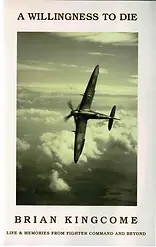
Brian's superb book,
"A Willingness to Die"
which was largely finished at the time of his death and was subsequently finished for him. A superb read about a 92 Squadron legend and true King Cobra
L to R: FO Garland (Eng Off), FO T Weiss (Intell), PO R Mottram, Sgt RE Havercroft, FLt CBF Kingcombe, SLdr JA Kent, FO TBA Sherrington, PO CH Saunders, FO RH Holland, FO AR Wright, Sgt H Bowen-Morris, Sgt JW Lund.